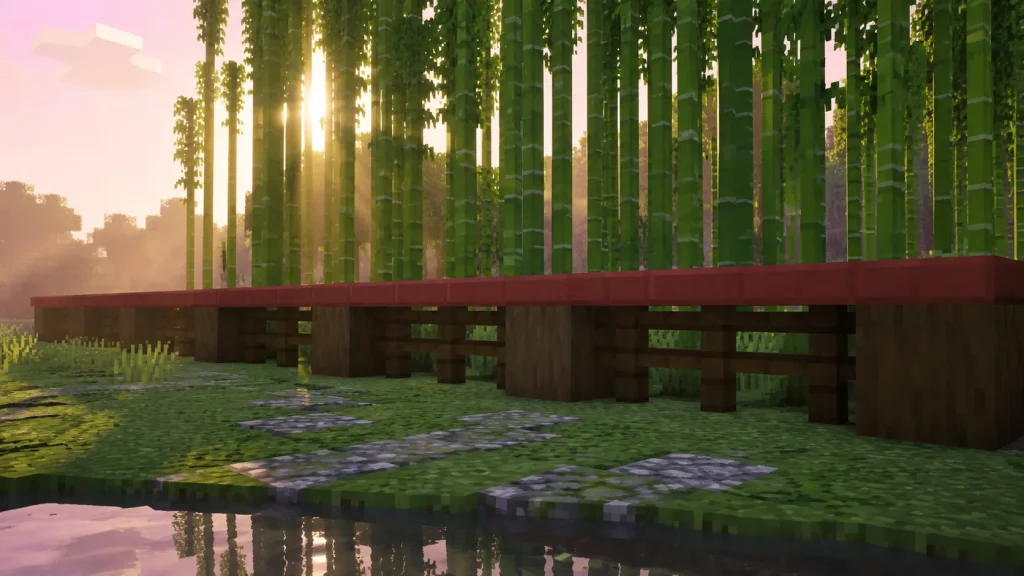
Walls are the most overlooked build in Minecraft. Everyone obsesses over the house and skips the boundary around it, but a good wall is what turns a build into a property — it frames the yard, keeps mobs out, and gives your base a first impression before anyone even reaches the door.
This list covers 30 wall styles, from clean modern concrete to fortified castle stone to a mangrove swamp version built almost entirely from roots and mud bricks. Pick one that matches your build’s theme, or borrow pieces from two different entries for a wall that’s uniquely yours.
Sleek & Modern Walls
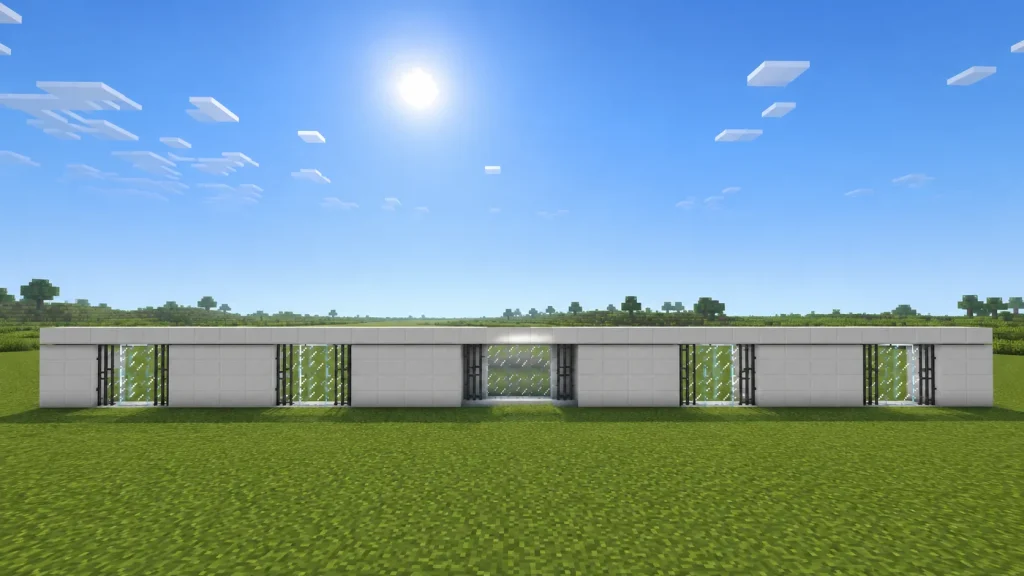
1. Modern Minimalist Wall
A low, flat-topped wall built from a single smooth block with tall glass panels breaking up the run every few blocks. No texture variation, no pattern — just clean horizontal lines with a slightly darker cap row.
Build it from smooth quartz block for the body, capped with a row of quartz slabs, and swap in floor-to-ceiling glass panes every four blocks instead of solid wall. Add black iron bars as thin vertical accents flanking each glass section.
Keep it two blocks tall at most — anything higher looks bulky against a modern house. Works best paired with a flat-roofed build in a plains or desert biome.
2. City Skyline Wall
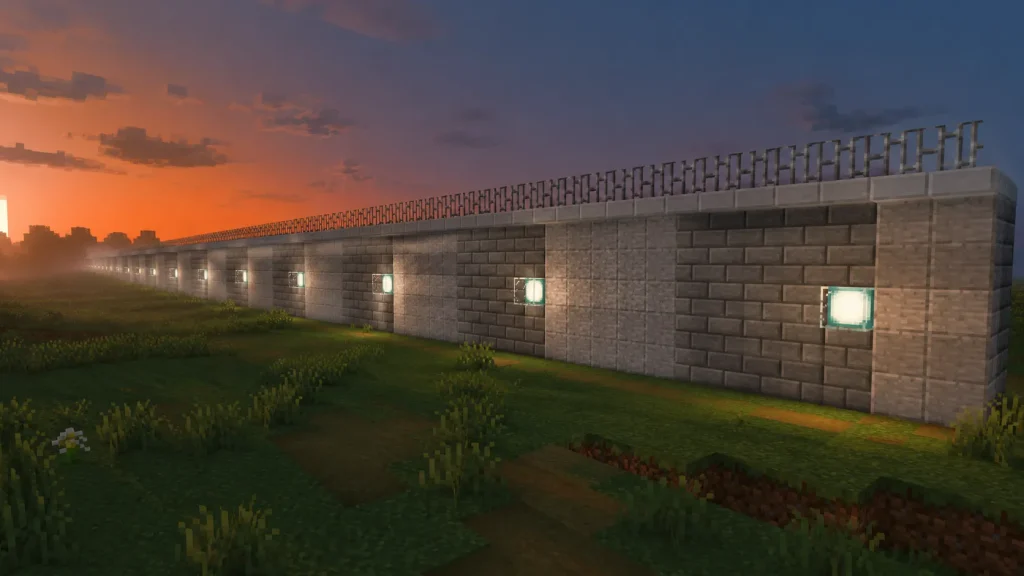
A tall block wall styled after an urban perimeter fence, dressed up with mounted lighting instead of decoration. Panels of stone brick alternate with sections faced in andesite for a two-tone concrete look.
The base structure is stone brick with polished andesite inset panels, topped with a smooth stone slab cap. Mount sea lanterns behind glass panes at even intervals to mimic streetlamps, and run iron bars along the top for a security-fence detail.
Space the lanterns every five to six blocks so the wall reads as lit at night without looking like a runway. Pairs well with any tall, boxy modern build.
3. Futuristic Glow Wall
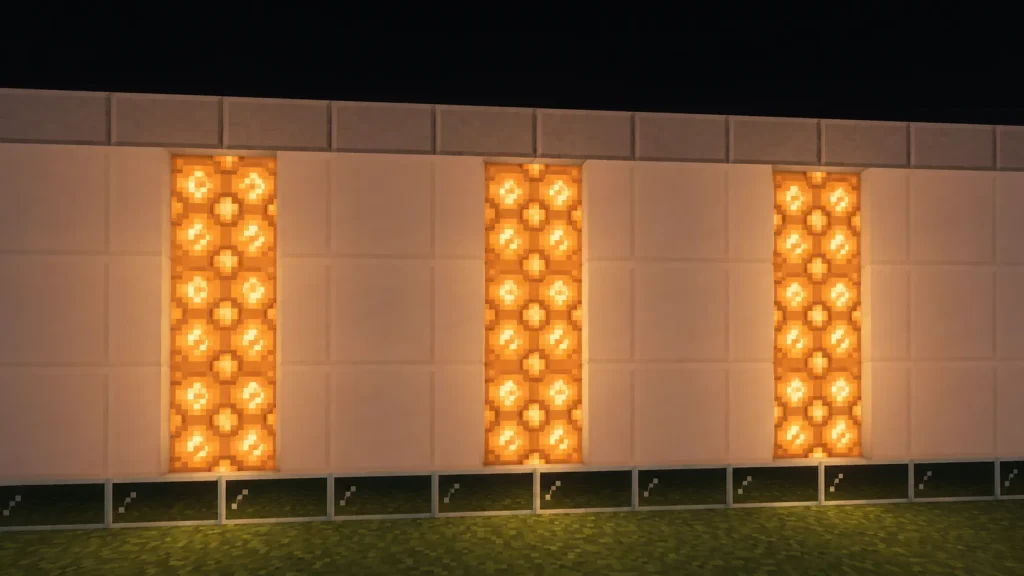
A sleek wall with an internal light source glowing through the block itself instead of sitting on top of it. The wall face is broken into narrow vertical panels that alternate solid and lit.
Build the frame from smooth quartz, and fill alternating panels with copper bulbs left in their unoxidized state so the glow stays bright. Cap the top with light gray concrete and add glass panes at the base for a floating-panel look.
Copper bulbs dim as they oxidize over time, so wax them if you want the glow to stay consistent. This one reads best at night or underground, where the light has something dark to stand out against.
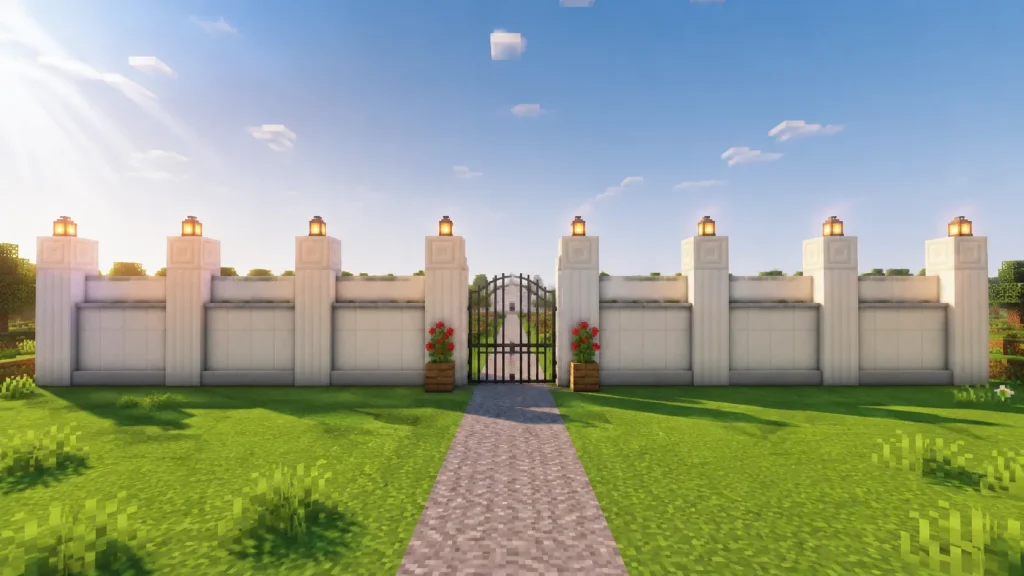
4. Expensive Quartz Estate Wall
A grand, symmetrical wall meant to look like it belongs in front of a mansion — thick pillars at regular intervals with a lighter, more delicate wall panel stretched between them.
Pillars are quartz pillar blocks capped with chiseled quartz, connected by a lower wall of quartz block topped with quartz stairs angled outward. Set a lantern on top of each pillar and flank the entrance with flower pots holding roses.
Space pillars every four blocks so the rhythm doesn’t get lost. Fewer, taller pillars read as grander than a busy row of short ones.
5. Fancy Ornamental Wall
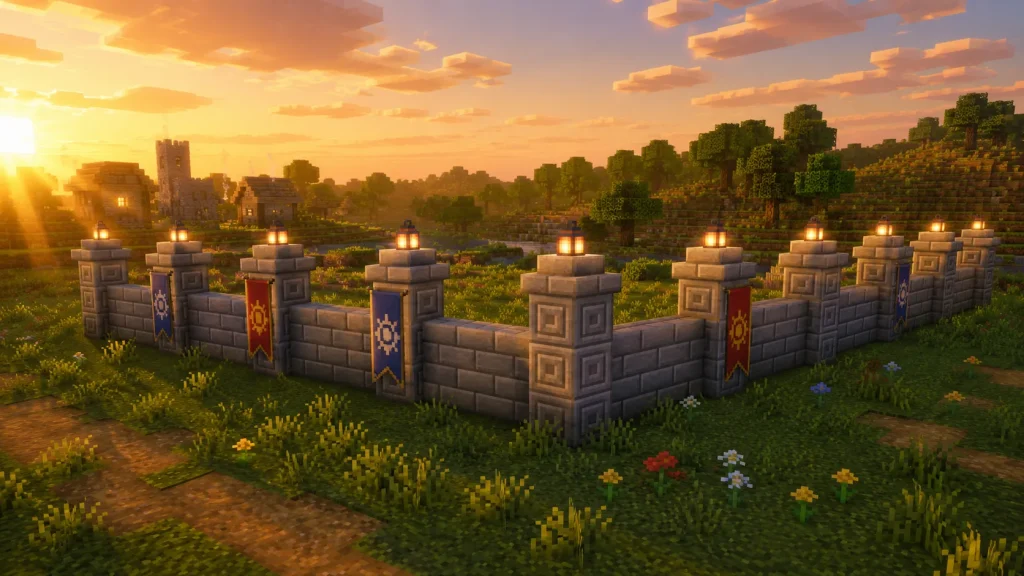
A decorative stone wall broken up by chiseled brick pillars, each one slightly taller than the wall itself so the tops peek above the skyline. Carved detail runs along the pillar faces.
The main wall is stone brick wall blocks, and the pillars are chiseled stone bricks stacked three high, capped with stone brick stairs pointing in on all four sides. Slot a lantern into each pillar top and hang a banner from the front face of every third pillar.
Alternate the banner colors every other pillar instead of matching them all. It keeps a long wall from feeling repetitive.
Rustic Wood & Farmhouse Walls
6. Wooden Fence Wall
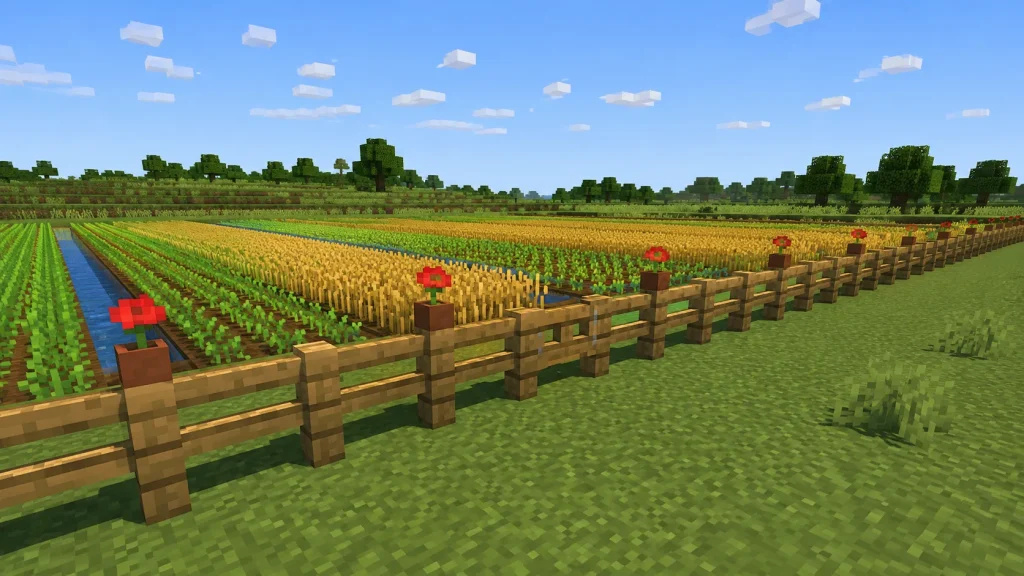
The simplest entry on this list, and still one of the coziest — a single row of oak fence with a gate every so often, no wall block involved at all.
Oak fence runs the full length, oak fence gates are spaced for entry points, and oak flower pots holding poppies sit mounted on every third post. Nothing on this wall stands taller than one block.
This is the one to use for a starter base or a farm perimeter. It keeps mobs out without blocking the view of what’s inside.
7. Palisade Log Wall
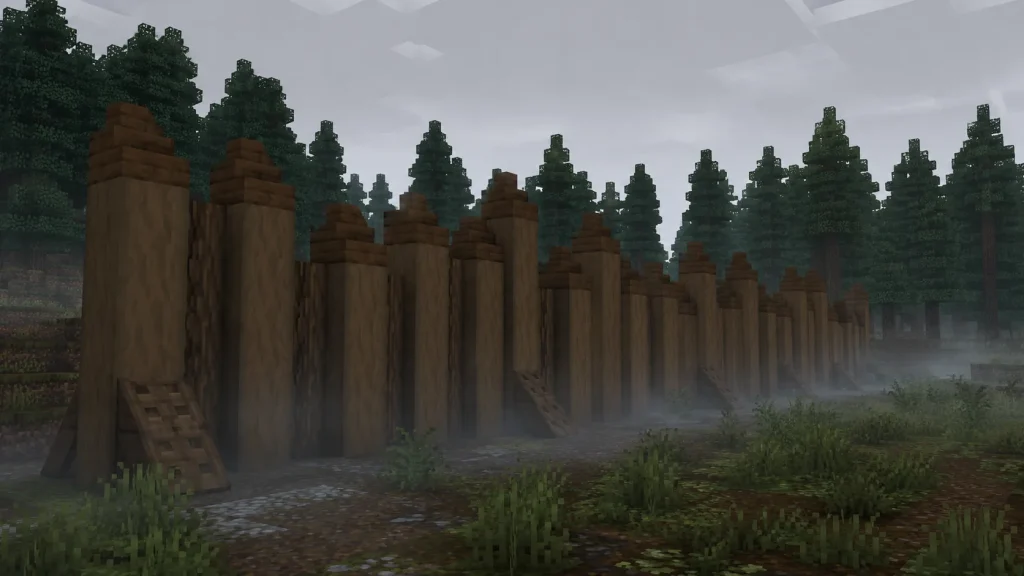
Upright logs standing shoulder to shoulder like a survival stockade, each one topped with a slightly pointed cap instead of a flat top. The look is rougher and more defensive than a planned fence.
Stripped spruce logs stand vertically for the main posts, with spruce stairs placed upside down on top of each one to fake a sharpened point. A few posts get tied together at the base with spruce trapdoors angled out as a lashed-look brace.
Vary the post height by one block here and there. A perfectly even palisade looks less like something someone built by hand.
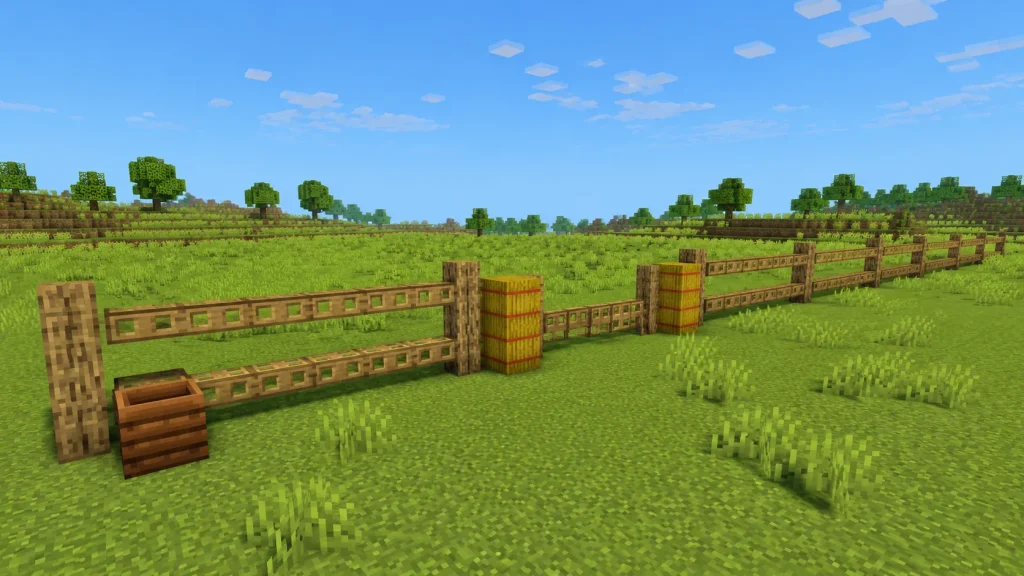
8. Ranch Rail Wall
A low, open horizontal rail fence, the kind that marks a property line without actually blocking sightlines. Wide gaps between rails keep it airy.
Oak fence posts sit every three blocks, connected by oak trapdoors turned sideways to act as horizontal rails, two rails high. Hay bales stack near the gate posts and a composter sits at one corner for the working-farm read.
Keep this one exactly two rails high — three starts to look like a real fence instead of a ranch boundary.
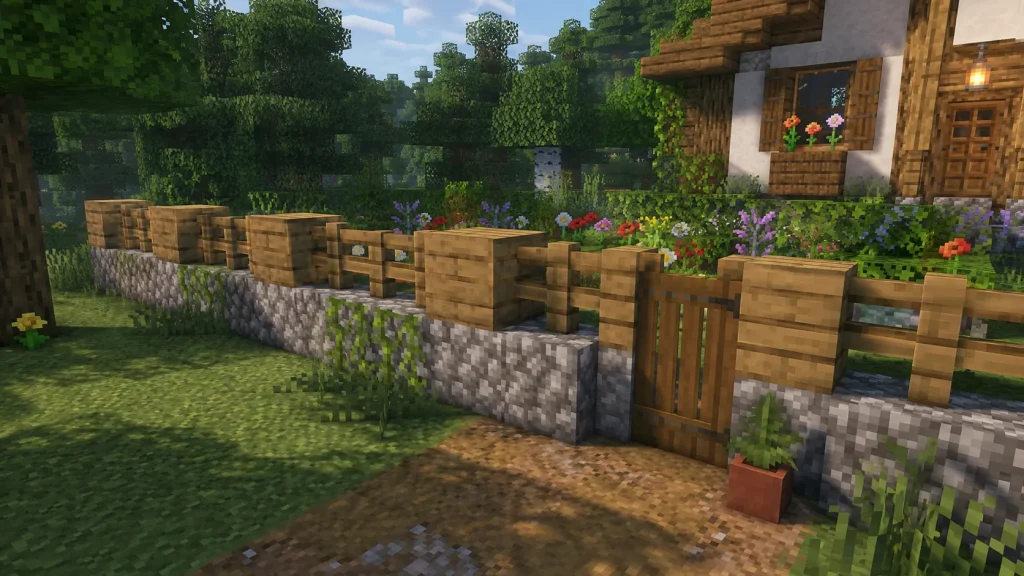
9. Oak Cottage Wall
A short, homey wall that looks handmade rather than engineered — cobblestone footing with an oak plank and fence combo on top, slightly uneven in height.
The base course is cobblestone one block tall, topped with oak planks and oak fence alternating along the run. Vines grow down the cobblestone section in a couple of spots, and a flower pot with a fern sits tucked beside the gate.
This pairs naturally with any oak cottage build. Match the fence type to your house’s wood and the wall stops looking like an afterthought.
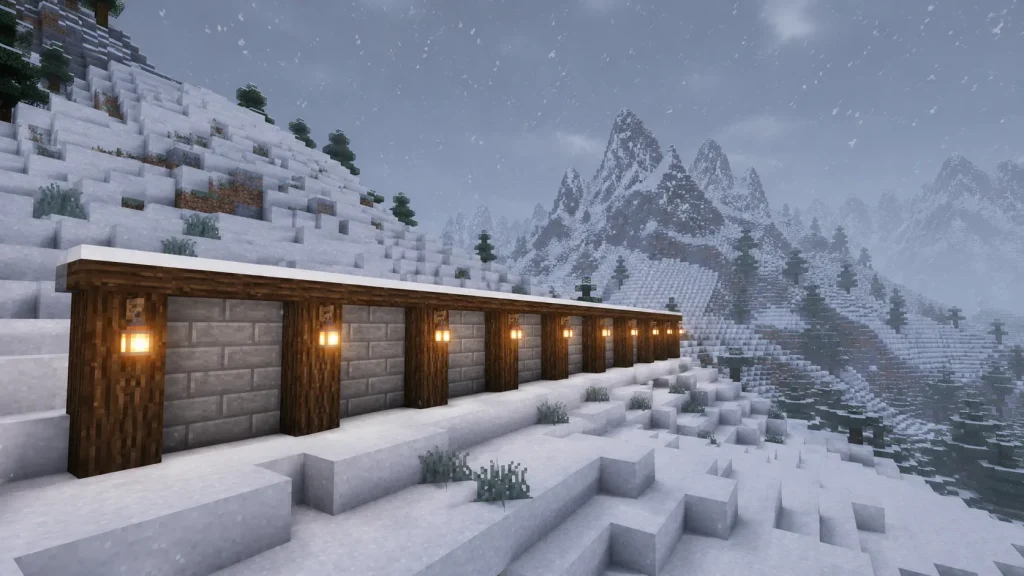
10. Spruce Cabin Wall
A stocky, mountain-cabin wall — thick spruce log posts with stone brick infill between them, built to look like it’s holding back snow rather than just marking a boundary.
Spruce log posts sit every three blocks, stone brick wall fills the gaps between them, and spruce slabs cap the whole run. A lantern hangs from every post, and snow layers sit on top of the cap blocks if the build is in a snowy biome.
Add a single spruce trapdoor gate rather than a full fence gate. It keeps the rustic, hand-built feel going.
Fortified & Medieval Walls
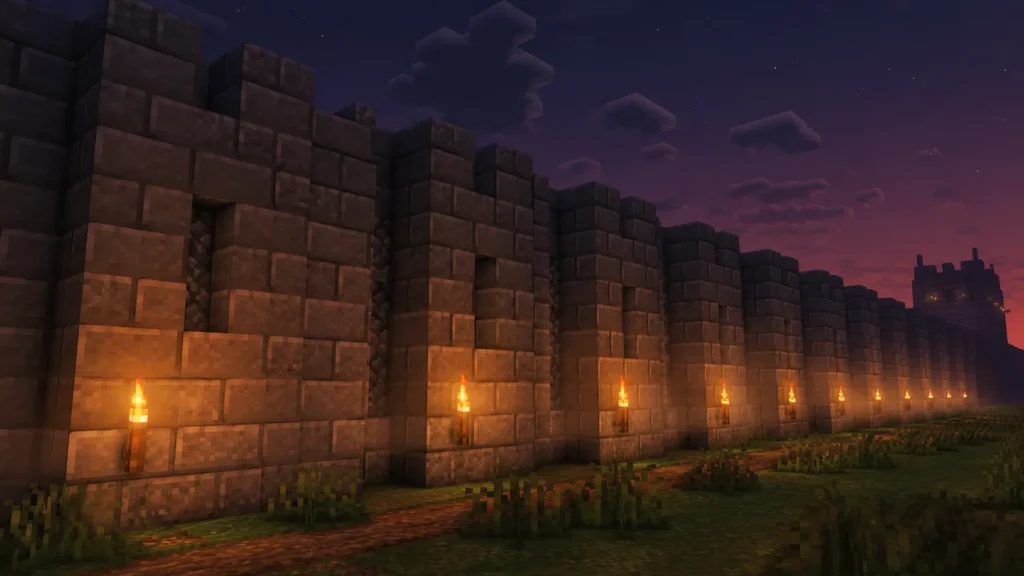
11. Fortified Stronghold Wall
A thick, no-frills defensive wall built for function first — solid stone from top to bottom with narrow gaps for visibility rather than windows.
A cobblestone core faced with stone brick rises to a stone brick wall row for crenellations. Narrow one-block gaps sit cut at eye height every few blocks, and torches light the base instead of lanterns for a rougher look.
Build this one at least three blocks tall. A fortified wall that’s too short just reads as a regular one.
12. Castle Battlement Wall
The classic crenellated top everyone pictures when they think “castle wall” — evenly spaced notches along the top edge, tall enough to walk behind.
Stone brick forms the main body, with stone brick wall blocks placed every other space along the top to form the battlements. Mossy stone brick stairs line the inside face as a walkway ledge, and a banner hangs between two of the merlons.
Leave a one-block gap behind the battlements for a walkway. It’s what makes the top actually usable instead of purely decorative.

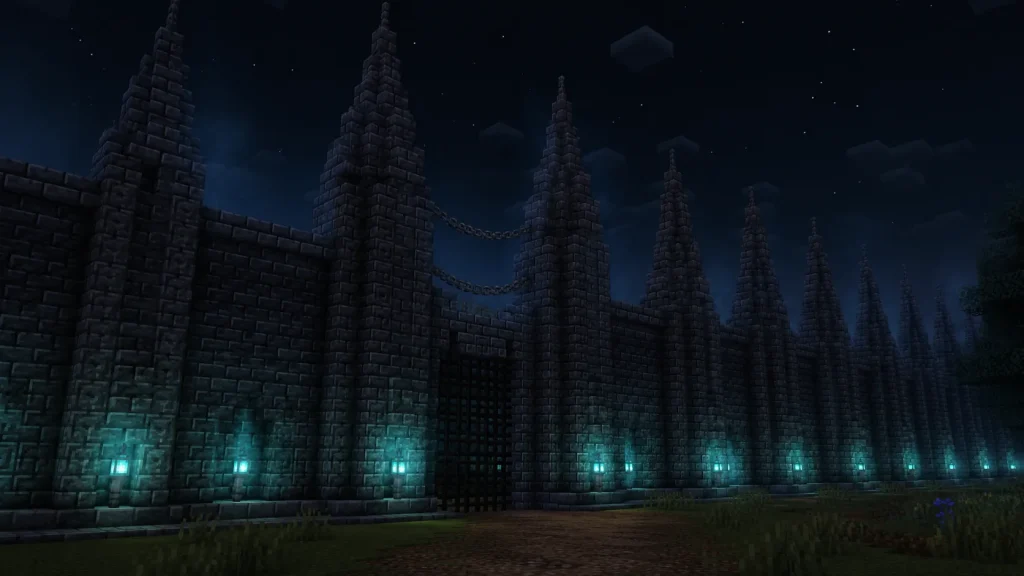
13. Gothic Spire Wall
A tall, narrow wall with pointed pillar tops that lean toward dramatic rather than defensive — dark stone with sharp vertical lines throughout.
Deepslate brick makes up the wall, with deepslate brick stairs forming steep pointed caps on each pillar section, and chains hang between two pillars near the gate. Soul lanterns sit in alcoves along the base for a cold blue-green glow.
Keep the color palette narrow here — deepslate and blackstone only. Warm wood tones would break the gothic read.
14. Evil Obsidian Wall
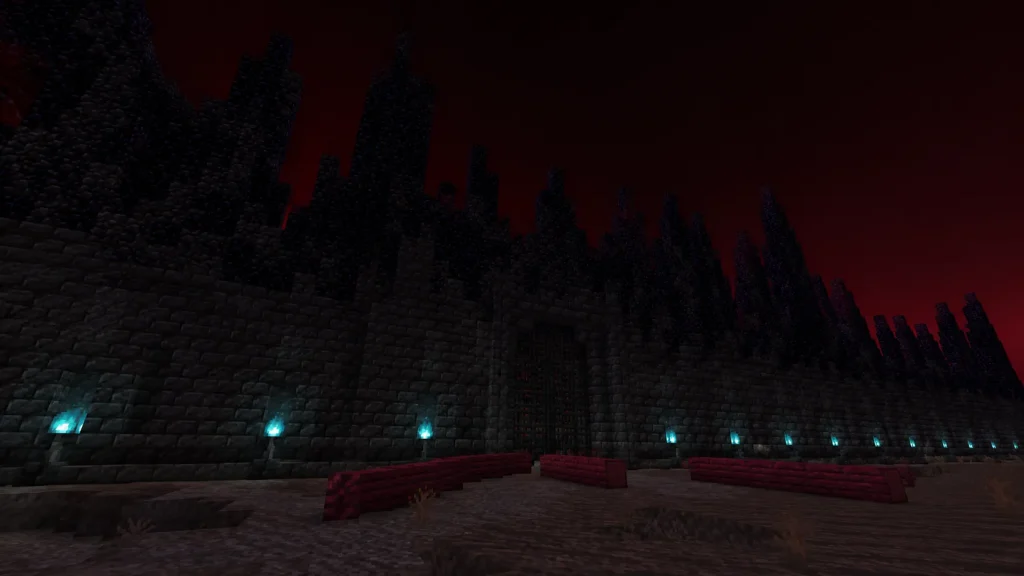
A blocky, intimidating wall meant to look like it belongs to a villain’s fortress — a jagged obsidian silhouette against a dark blackstone base.
Obsidian forms the upper jagged sections, blackstone fills the lower wall, and soul fire lanterns replace regular ones for an eerie blue-green light. A few crimson stems lie horizontally near the gate as broken beam details.
Obsidian is expensive to mine in bulk, so a thinner obsidian cap over a blackstone base gets the same silhouette for a fraction of the material.
15. Pillar Colonnade Wall
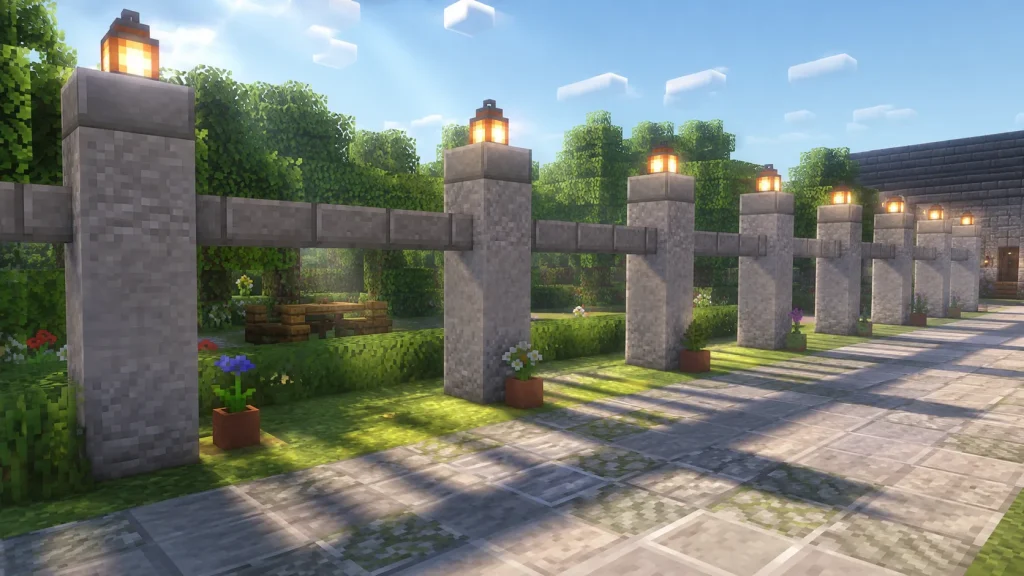
A wall made almost entirely of repeating pillars with a thin connecting wall between them — more architecture than barrier, meant to be walked past and admired.
Andesite pillars capped with polished andesite connect through a single-block-tall stone brick wall between each pair. A lantern sits on every pillar top, and a flower pot rests at the base of every other one.
This works better as a garden or courtyard divider than a perimeter wall. It’s too open to actually keep anything out.
Garden & Nature Walls
16. Hedge Garden Wall
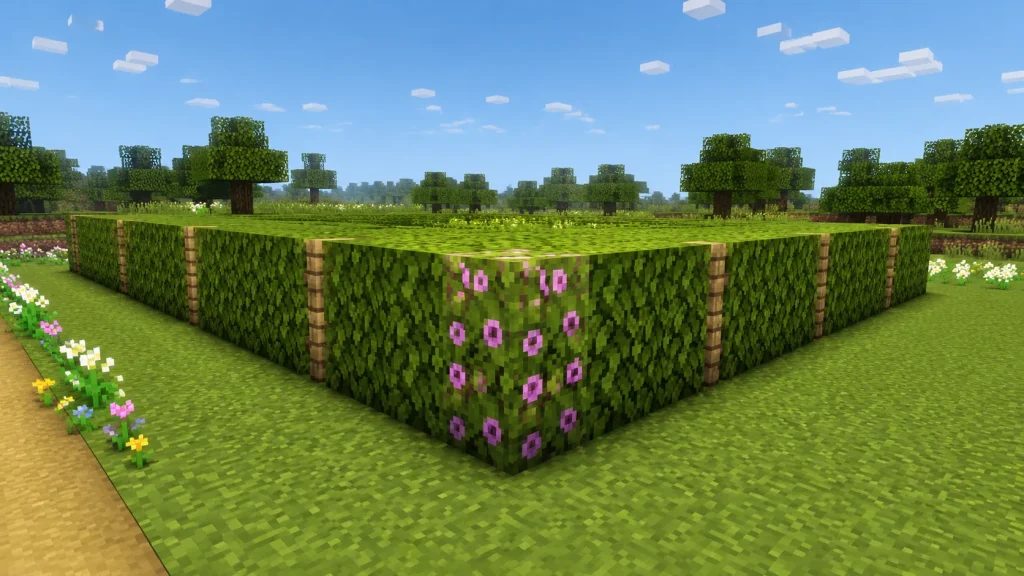
A living wall trimmed to look sculpted rather than wild — solid green with just enough shape variation to read as intentional landscaping.
Oak leaves form the main hedge body, kept two blocks tall and pruned into a flat top, with a cut oak fence post every five blocks for structure. A flowering azalea bush sits at each corner where the hedge turns.
Leaves need light to stay alive, so keep this one outdoors. It won’t hold up as an underground or covered wall.
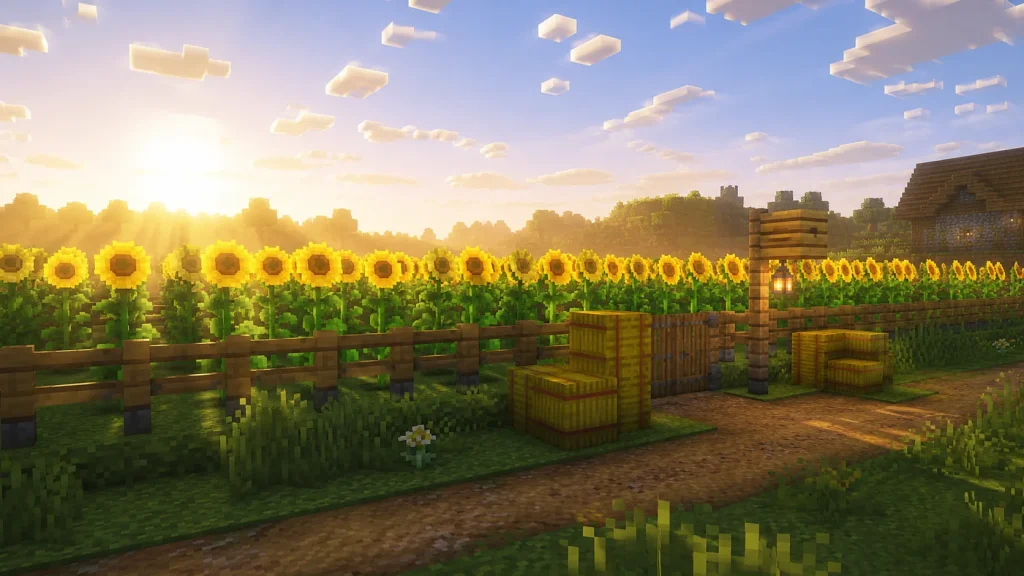
17. Sunflower Field Wall
Less a wall and more a bright border — a low fence line with a dense row of sunflowers standing behind it, taller than the fence itself.
Oak fence marks the boundary line, backed by a full row of sunflowers planted two deep so they read as a field rather than a single line. A few hay bales sit near the gate, with a beehive nearby for the farm feel.
Sunflowers always face the direction the sun rises from, so plant them where morning light hits for the best look in screenshots.
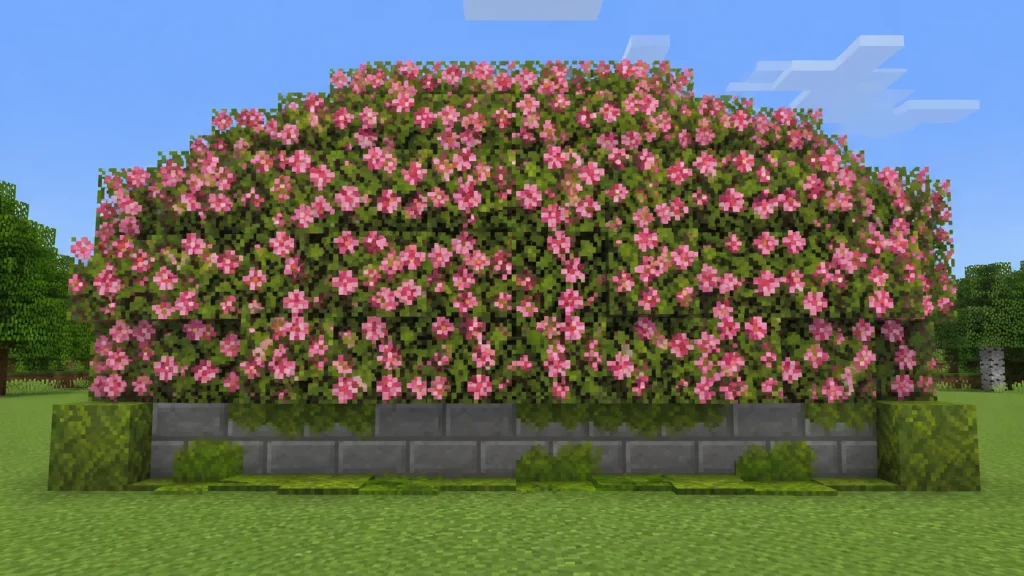
18. Azalea Blossom Wall
A soft, pink-toned wall that leans on plant blocks instead of stone for most of its bulk — flowering azalea stacked into a dense, rounded hedge shape.
Flowering azalea bushes form the bulk of the wall, backed by a low stone brick footing to keep the shape from spreading. Moss carpet spills over the stone base, and a couple of moss blocks sit tucked at the corners.
Flowering azalea only blooms pink when planted mature — grown from a sapling it can look plain green at first, so place full bushes directly for the color right away.
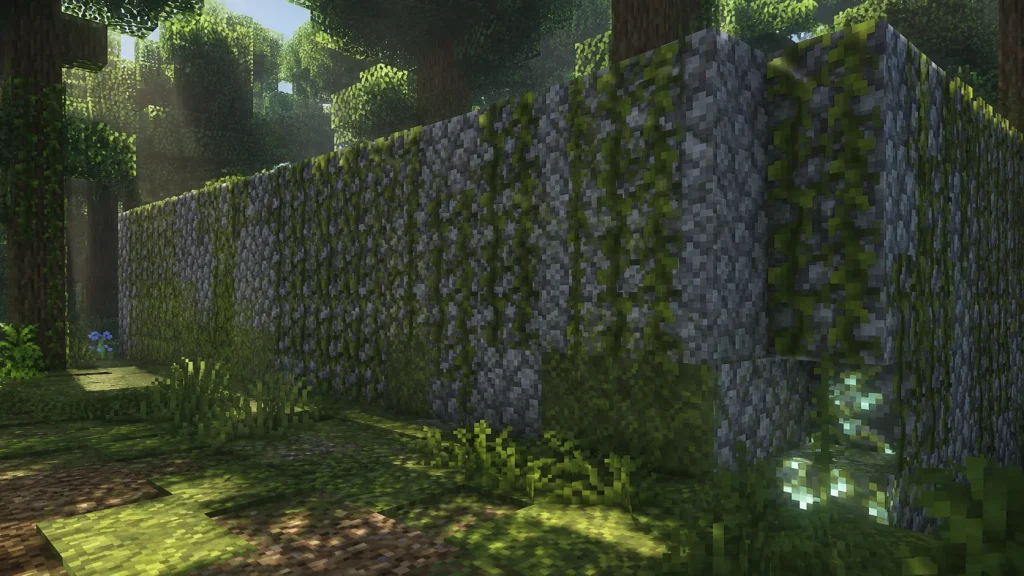
19. Natural Vine Wall
A plain stone wall that looks reclaimed by the landscape — vines climbing most of its face, softening the hard edges of the stone underneath.
Cobblestone forms the base structure, with vines placed on nearly every face and moss carpet creeping up from the ground on one side. A single glow lichen patch tucked in a shaded corner adds a small green-white highlight.
Vines spread on their own over time, so plant just a few and let them grow rather than covering the whole wall by hand.
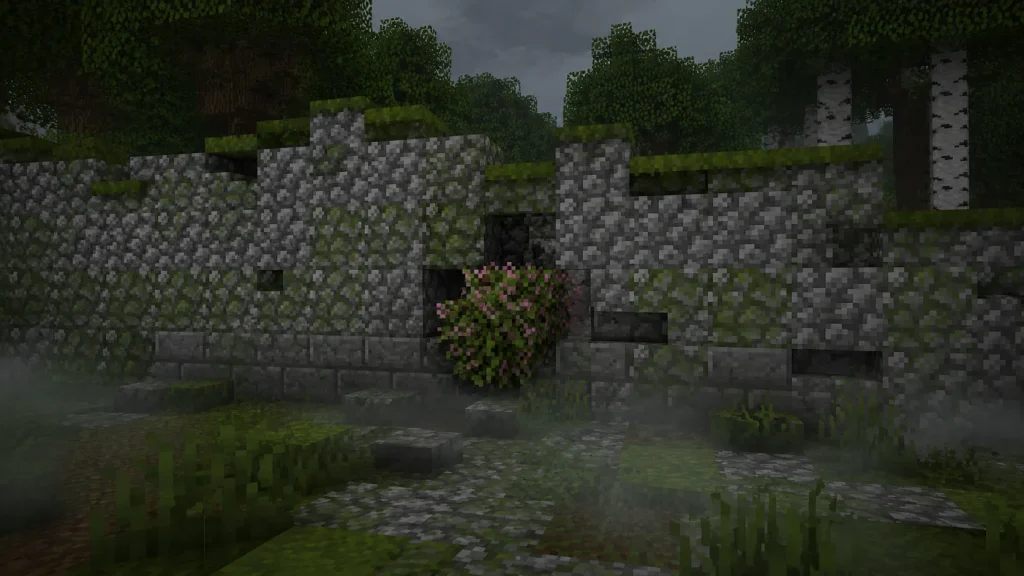
20. Mossy Overgrown Wall
A wall that reads as abandoned and reclaimed — patchy moss coverage over stone that’s clearly seen better days, no clean lines anywhere.
Mossy cobblestone mixes unevenly with regular cobblestone for the body, moss carpet layers on top of the cap blocks, and cracked stone bricks work in near the base. A cluster of flowering azalea grows out of one gap where a block is missing.
Leave a couple of gaps in the wall entirely. An overgrown wall should look like it’s slowly falling apart, not just green-tinted.
Stone & Terrain Walls
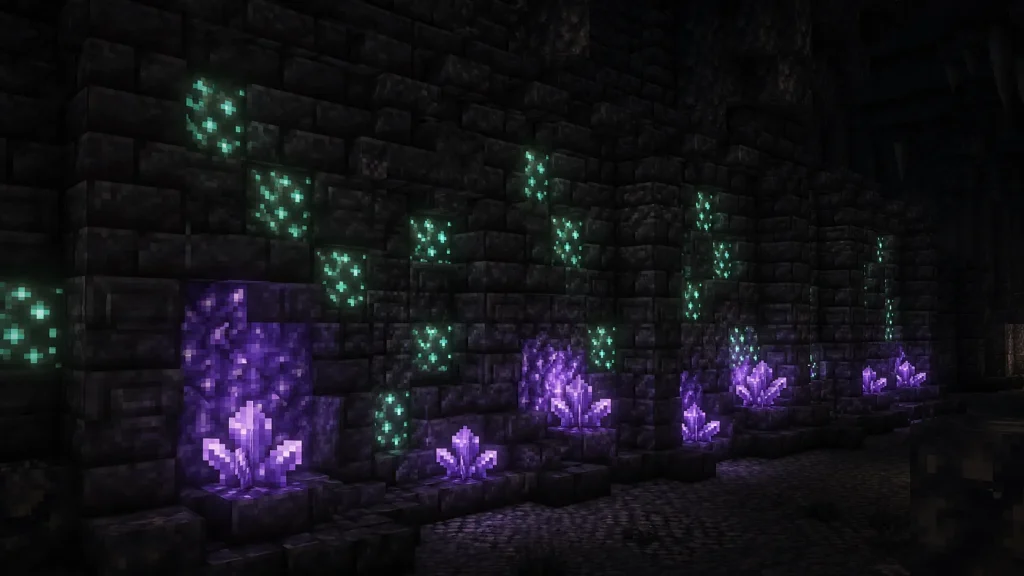
21. Deepslate Cave Wall
A dark, dense wall meant for an underground base — deepslate from top to bottom with the occasional crystal cluster breaking up the black-grey surface.
Deepslate bricks form the main body, capped with deepslate brick stairs, and a scattering of amethyst clusters grows directly out of the wall face near the base. Glow lichen patches sit in the gaps between bricks for ambient light.
Skip torches entirely on this one. Let the amethyst and lichen be the only light sources for a proper cave-base atmosphere.
22. Arched Stone Wall
A wall broken up by a series of open stone arches instead of a solid run — more visually interesting than a flat wall and lets light through.
Stone brick forms the arch shapes, built three blocks wide with stone brick stairs curving the top of each opening, connected by short solid stone brick sections between arches. A flower pot sits in the solid section between each arch.
Space the arches evenly and keep the solid sections between them shorter than the arch openings, or the wall starts to look more solid than open.

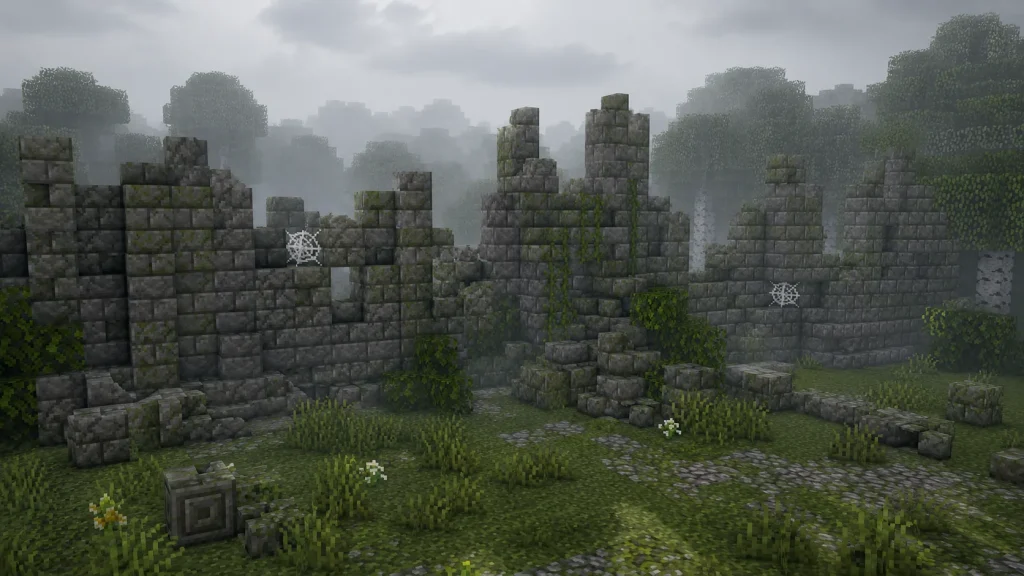
23. Weathered Ruin Wall
A wall that’s deliberately incomplete — sections crumbled away, cracked stone worked in throughout, no consistent height along its length.
Cracked stone bricks mix with regular and mossy stone brick, with entire sections dropped to half height or missing a block or two on purpose. Cobwebs sit in a couple of the gaps, and a single stretch of vines climbs up from a fallen section.
Vary the height randomly rather than in a repeating pattern. Real ruins don’t crumble symmetrically.
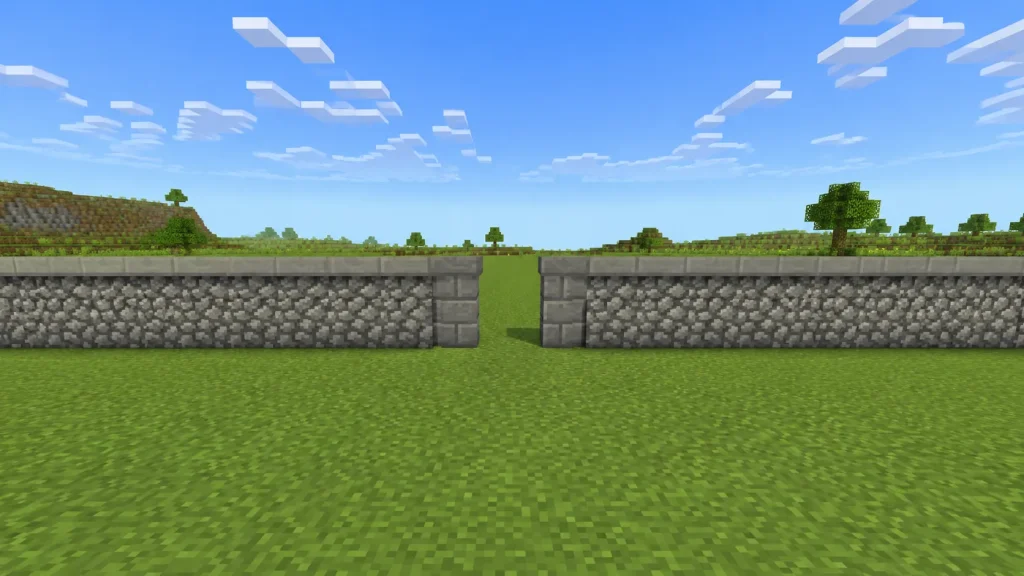
24. Classic Stone Wall
The reliable, no-frills version everyone builds first — even cobblestone blocks in a straight, uniform run with a simple capped top.
Cobblestone makes up the entire body, capped with stone brick slabs for a slightly cleaner top edge. A stone brick wall gate post marks each entrance point.
This is the easiest wall on the list to build early-game, since cobblestone is the first stone-tier block most survival players stockpile.
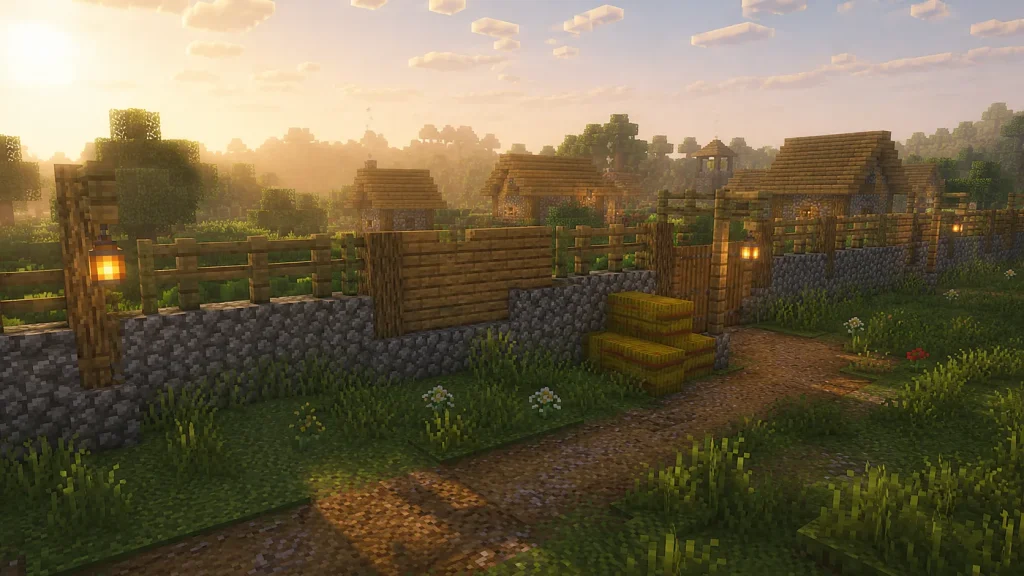
25. Village Perimeter Wall
A practical, lived-in wall styled after what a village would actually build to keep mobs out — mismatched materials that suggest it was added to over time.
A cobblestone footing is topped with oak fence and the occasional oak plank patch where a section looks repaired. Hay bales stack near the main gate, and a lantern hangs from a fence post every six blocks.
Don’t make the materials too uniform. A village wall should look assembled by different people at different times, not built in one pass.
Biome & Themed Walls
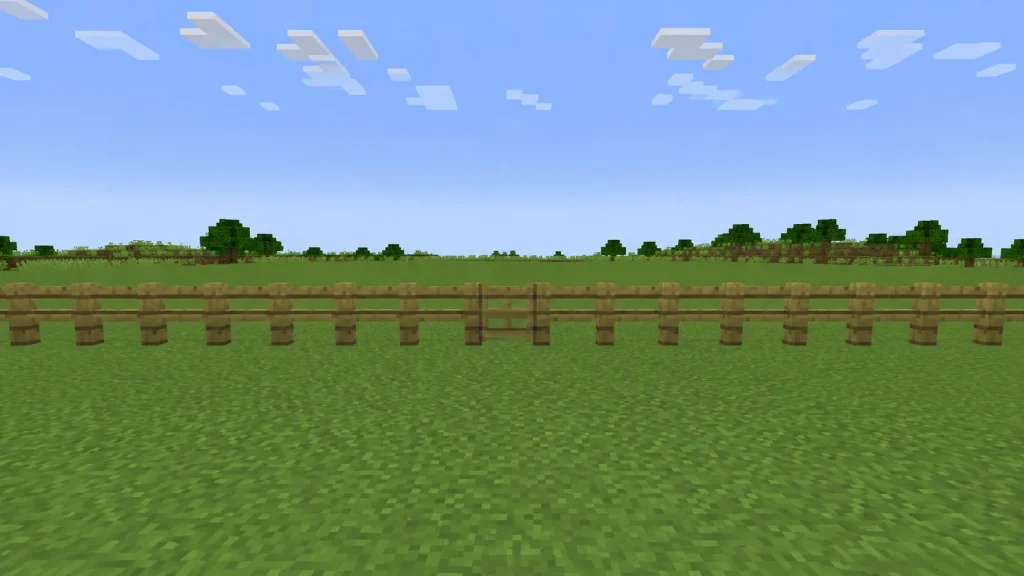
26. Simple Fence Wall
The most basic version on this list, and the one every new build starts with — a plain fence line with nothing decorative added.
Oak fence runs the length, with an oak fence gate at the entrance and nothing else. No lanterns, no plants, no accent blocks.
Swap the wood type to match whatever’s already in your build instead of defaulting to oak. A spruce or dark oak fence reads completely differently.
27. Mangrove Swamp Wall
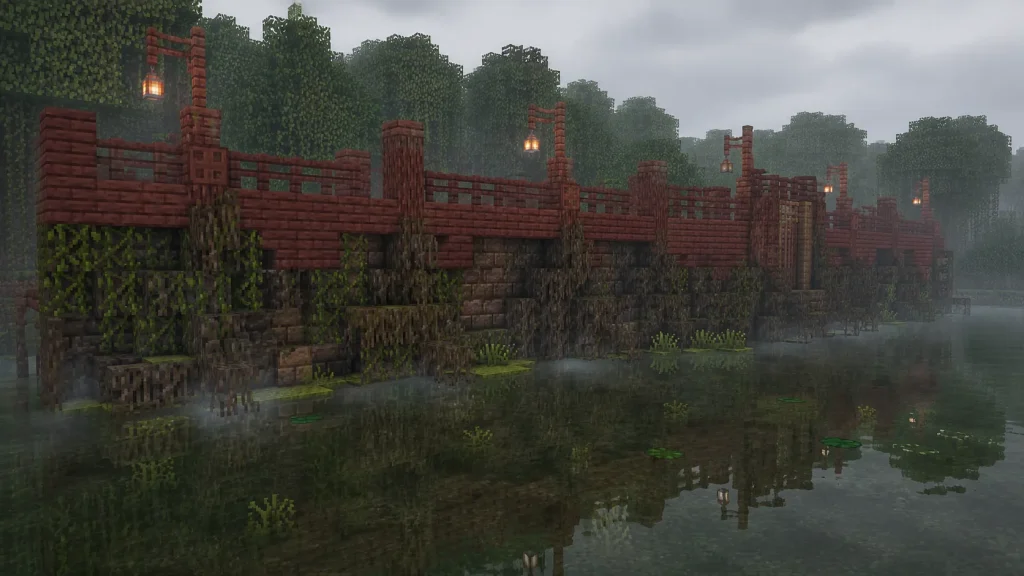
A wall grown as much as built — mangrove roots tangled at the base with a more structured mangrove-wood section rising above the waterline.
Mangrove roots form the lower, irregular section, transitioning into mangrove planks and mangrove fence for the upper wall. Mud bricks fill a couple of gaps near the base, and moss carpet sits wherever the roots meet solid ground.
Build this one partially in shallow water for the full effect. The roots are meant to look like they’re growing out of a swamp, not sitting on dry land.
28. Desert Sandstone Wall
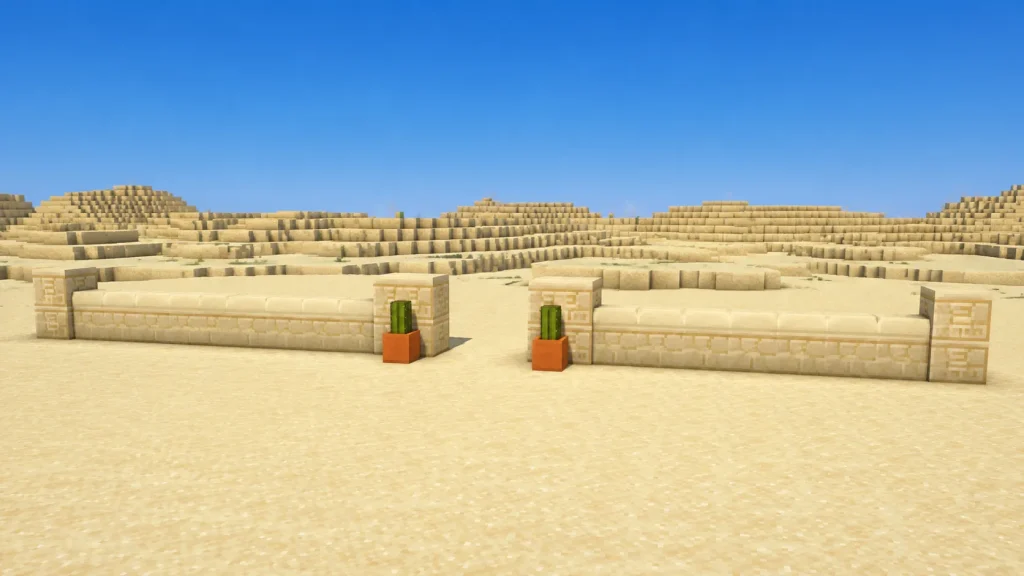
A sun-bleached wall matched to its biome — warm tan tones throughout, low and wide rather than tall, since desert builds tend to stay close to the ground.
Cut sandstone makes up the main body, capped with smooth sandstone stairs, and chiseled sandstone pillars mark each end of a section. A couple of cacti sit near the gate in terracotta-colored planters.
Keep the wall under three blocks tall in a desert build. Anything taller starts to block the wide-open sightlines that make desert bases work.
29. End Realm Wall
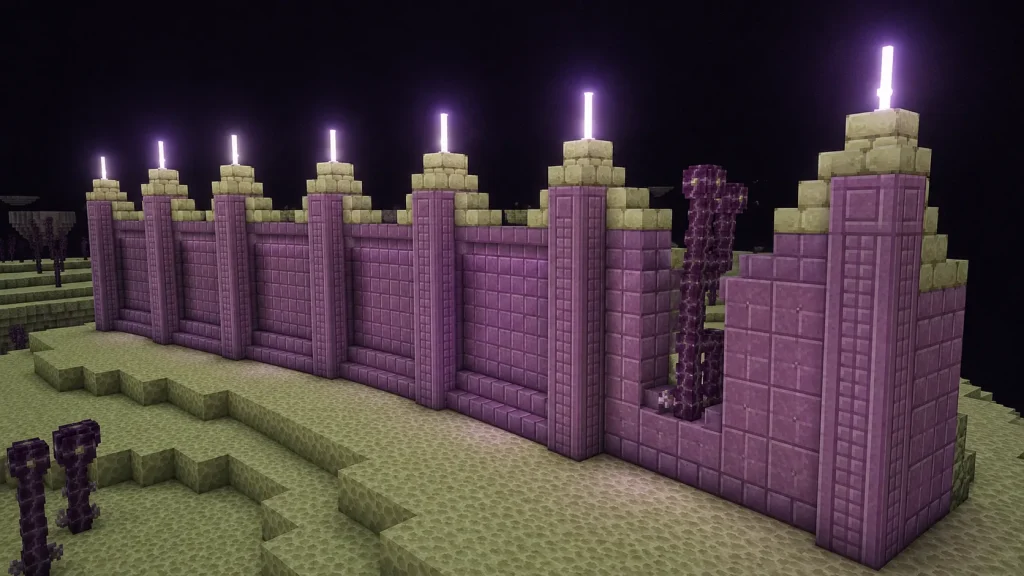
An otherworldly wall that doesn’t try to look like it belongs on the Overworld — pale purple tones and impossible floating detail instead of a grounded, practical shape.
Purpur block and purpur pillar form the main structure, capped with end stone brick stairs, and end rods mount along the top in place of lanterns. A chorus plant grows out of a gap near one corner.
This one only makes sense paired with an End-themed build. Dropped into a plains or forest biome, the purple tones clash with everything around it.
30. Japanese Garden Wall
A low, elegant wall styled after a traditional garden fence — dark wood tones with a tiled cap row instead of a flat top.
Stripped dark oak logs form vertical posts, connected by dark oak fence panels, and capped with a row of dark red terracotta acting as a tiled roof edge. Bamboo planted just behind the wall adds height without blocking the view over it.
Keep this one under two blocks tall. Traditional garden walls are meant to be looked over, not blocked by.