

Pillars do a lot of quiet work in a build. They hold up a roof, break up a long wall, frame an entrance, or just add rhythm to an empty room. Most people default to a plain 1×1 stack of stone and walk away.
This list gives you 15 pillar designs worth stealing, sorted by style so you can match one to whatever you’re building. Some are grand temple columns, some are cozy porch posts, and a few of them glow.
Every design sticks to blocks you already have or can grab easily, with the exact palette written out so you can copy it block for block.
Grand & Classical Pillars
1. Fluted Quartz Colonnade
This is the classic white temple column, repeated in a row to build a colonnade along a walkway or the front of a grand hall. The vertical grooves in the quartz read as fluting from a distance, which sells the ancient look instantly.
Stack quartz pillar blocks for the shaft so the grooves run vertically, then cap the top and bottom with chiseled quartz for the capital and base. Flare the foot outward with quartz stairs, and rest everything on a raised platform of smooth quartz slabs. Run a smooth quartz beam across the tops to tie the row together.
Space the columns three to four blocks apart. Too tight and it looks like a wall; too wide and the roof above sags visually.

2. Weathered Sandstone Temple Column
A desert-worn column that looks like it has survived a few thousand sandstorms. The trick is deliberate damage: gaps, mismatched blocks, and a chunky silhouette that has lost its crisp edges.
Build the shaft from cut sandstone, then swap one or two blocks for plain sandstone to break up the texture like erosion. Top it with chiseled sandstone, sit it on a smooth sandstone base, and flare the bottom with sandstone stairs. Leave the very top ragged by pointing a couple of stairs outward instead of adding a clean cap.
These look best half-buried in sand or lined up along a cracked temple courtyard. Pull a block or two out entirely for the abandoned-ruin feel.

3. Chiseled Deepslate Obelisk
Not a support column but a monument, a tall dark spike that tapers as it climbs. It works as a landmark at a gate, a corner marker on a wall, or a centerpiece in a shadowed courtyard.
Build the body from deepslate bricks and step it inward one block every four or five layers so it narrows toward the top. Set chiseled deepslate panels into the mid-section faces, base it on polished deepslate, and cap it with a single deepslate tile point. Tuck soul lanterns into small recesses near the bottom for a cold blue glow.
Height sells it. Anything under ten blocks reads as a stump, so commit to at least twelve.

4. Grand Stone Brick Column
A palace-grade column with a heavy capital and base, built entirely from the stone brick family so it fits almost any medieval or town build. It is the reliable middle ground between a plain stack and something fussy.
Run stone bricks up the shaft with a chiseled stone brick block set in as a decorative mid-band. Build out the capital and base using stone brick stairs and slabs layered into a flared, stepped shape. Frame the shaft on all four sides with stone brick walls to fake the fluting.
Hang a lantern on a chain from the underside of the capital if the column stands in an interior hall. The pool of light makes the stone read warmer.

Medieval & Fortress Pillars
5. Mossy Cobblestone Ruin Pillar
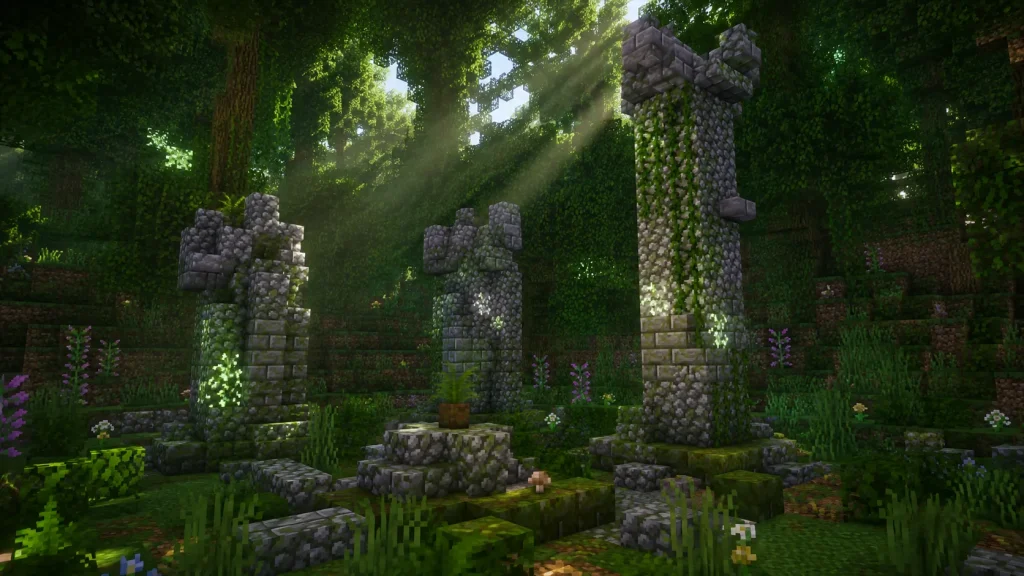
A pillar that is already half-fallen, perfect for ruins, overgrown temples, or a garden meant to feel forgotten. The broken top does most of the storytelling.
Stack mossy cobblestone for the shaft with a mossy stone brick block or two banded in for variety. Cap it with an uneven ring of cobblestone walls, then snap the top by facing a few stairs outward like fallen chunks. Trail vines down one face, dust the base with moss carpet, and speckle glow lichen across the shaded side.
Build two or three at different heights and knock one down to a stump. A row of identical ruins looks staged; mismatched ones look real.
6. Timber-Framed Great Hall Column
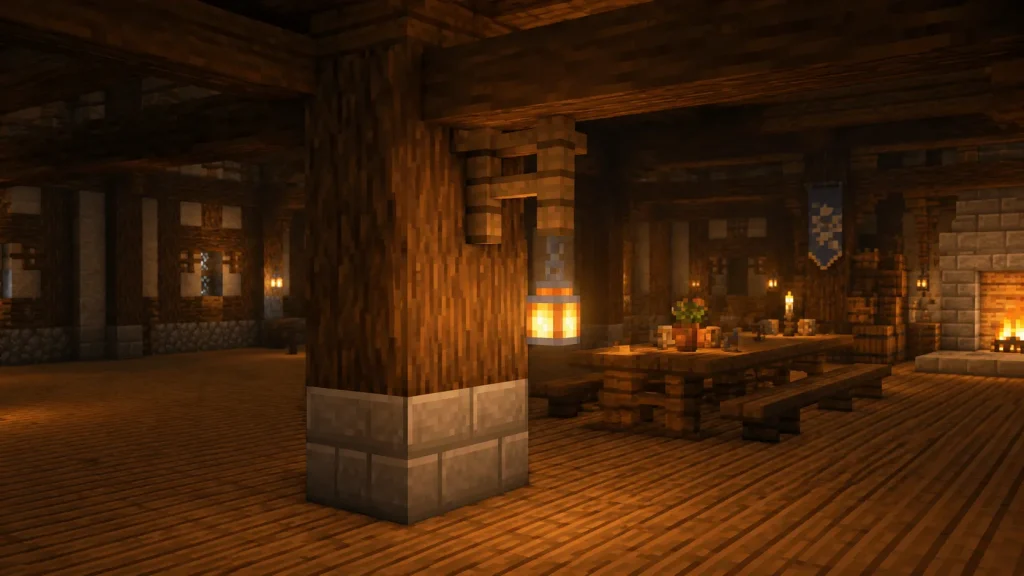
The workhorse support column for a medieval great hall or tavern, mixing a stone footing with exposed timber above. It looks structural because it basically is.
Start with a short stone brick plinth at the floor, then run a dark oak log upright as the main post. Lay stripped dark oak logs on their side near the top as cross-beams reaching toward the neighboring columns, and brace the corners with dark oak fences. A single lantern hung off the bracing finishes it.
Keep the logs upright for posts and sideways for beams. Matching the wood grain to its job is what makes timber framing look intentional instead of random.
7. Blackstone Gothic Pillar
A tall, severe cathedral column meant to be lined up so the tops spring into pointed arches. This is the backbone of any gothic hall, crypt, or dark chapel.
Build the shaft from polished blackstone bricks with a chiseled polished blackstone block as a mid-band, and wrap the base in blackstone walls for weight. At the top, angle blackstone stairs outward toward the next column so the gaps between pillars start to close into arches. A touch of gilded blackstone near the capital adds a glint, and soul lanterns keep the light appropriately grim.
Space these evenly and identically. Gothic architecture lives on repetition, so consistency between columns matters more here than on any rustic build.

Natural & Rustic Pillars
8. Mangrove Root Wrapped Trunk Pillar
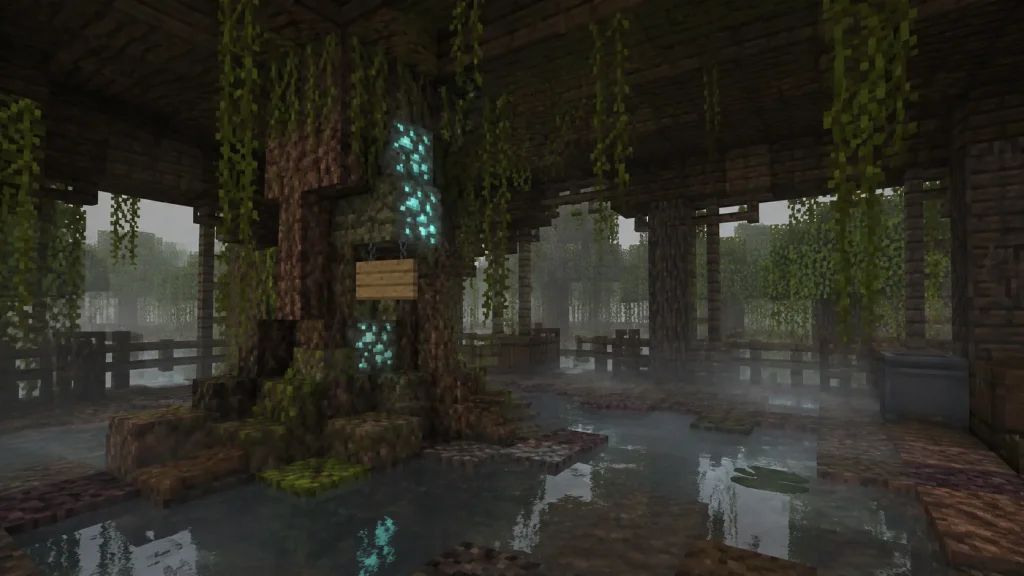
A living, organic column that looks grown rather than built, ideal for swamp huts, jungle temples, or a druid-style hall. It reads as a tree that has been pressed into service as a support.
Core the pillar with a mangrove log, then wrap the shaft in mangrove roots so the surface goes gnarled and uneven. Spread muddy mangrove roots around the base like it is rising out of wet ground, carpet the foot in moss, and let a few vines hang from the top. Dab glow lichen on for faint natural light.
Alternate patches of bare log and root wrapping instead of covering the whole shaft evenly. The irregularity is the entire point.
9. Flowering Garden Column
A decorative garden pillar that is more planter than support, crowned with foliage and dripping with flowers. Use it to anchor the corner of a courtyard or flank a path.
Run stone bricks up the shaft with mossy cobblestone worked in for age. Stick out a few birch trapdoors as small ledges and set flower pots on them, then crown the top with flowering azalea leaves spilling over the edges. Moss carpet at the base ties it into the garden bed.
Vary the flowers in each pot rather than repeating one type. Mixed blooms look like a real planting; a single flower looks like decoration you forgot to finish.

10. Birch Cottage Lantern Post
The simplest pillar here, and often the most useful, a slim porch post with a lantern arm, sized for cottages, market stalls, and fence lines. Nothing grand, just tidy and warm.
Use a stripped birch log as the post and collar it near the top with a birch trapdoor on each face for a subtle capital. Stick a birch fence out sideways as a bracket and hang a lantern from it. A birch slab caps the bottom where the post meets the ground.
These are cheap enough to line a whole fence with. Spacing them every five or six blocks along a path lights it without a single torch in sight.

Modern & Industrial Pillars
11. Copper Steampunk Support Column
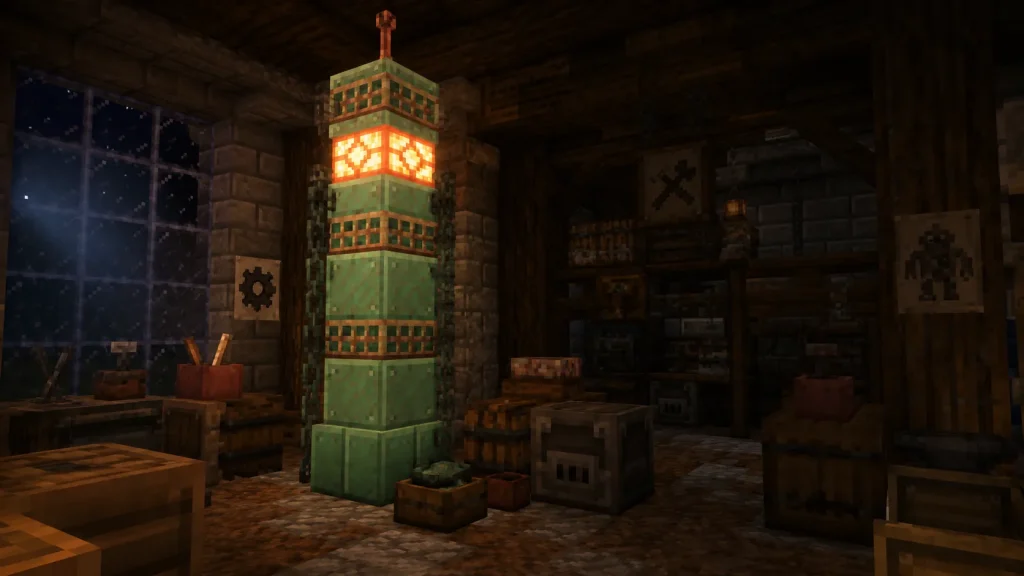
An industrial column bristling with rivets, pipes, and a warm bulb glow, built for workshops, airship docks, or any contraption room. The green-tinged patina does the aesthetic heavy lifting.
Run exposed copper blocks up the shaft and band it with copper grate for a riveted, ventilated look. Base it on cut copper, run chains alongside as piping, and set an exposed copper bulb near the top as the light. Finish with a lightning rod as a finial poking off the cap.
Pick one oxidation stage and hold it across every column. Mixing shiny and green copper on the same pillar looks like a mistake rather than a choice, and exposed sits in a nice middle patina.
12. Smooth Quartz and Glass Modern Pilaster
A flat pilaster that sits half-recessed into a wall, built for modern houses and glass towers where a round column would look wrong. It breaks up a blank facade with a clean vertical line of light.
Face the pilaster in smooth quartz blocks with quartz slabs as thin trim edges. Recess a strip of gray stained glass pane down the center and hide a sea lantern behind it so the whole seam glows evenly. A polished diorite block grounds the base.
Sink the pilaster one block deep into the wall so it protrudes just slightly. A column that sticks out too far stops reading as modern.

13. Tuff Brick Minimalist Pillar
A clean, neutral gray column with barely any decoration, made to disappear into modern and industrial builds without drawing attention. Sometimes the point of a pillar is not to be noticed.
Build the shaft from tuff bricks, mark a single chiseled tuff block as a quiet mid-band, and cap and base it with polished tuff for a smoother contrast. Set the whole thing on a low tuff slab plinth.
This is the most flexible column on the list. Its muted gray sits under warm wood, cool concrete, or bright quartz without clashing with any of them.

Fantasy & Glowing Pillars
14. Amethyst Crystal Glow Pillar
A magical column that looks like it grew out of an amethyst geode, studded with crystals and giving off a soft purple light. Drop it into a wizard tower, an enchanting room, or a deep cave shrine.
Core the shaft in calcite for that pale geode-wall look and hide a column of glowstone inside it. Stud the outer faces with amethyst clusters and smaller amethyst buds sprouting at angles, and work in a couple of budding amethyst blocks so the growth looks alive. Set purple stained glass panes over the glowstone so light leaks out in bands, and anchor the base with smooth basalt.
Cluster the crystals unevenly, heavier near the middle and sparser at the ends. Even spacing kills the natural-growth illusion.

15. Prismarine Ocean Monument Column
A glowing aquatic column pulled straight from ocean monument architecture, equally at home submerged, lakeside, or in an atrium with a pool. The shifting prismarine tones and lantern glow make it feel underwater even on dry land.
Build the shaft from prismarine bricks and band it with dark prismarine for contrast. Set sea lanterns flush into the faces as glowing panels, ring the base with prismarine stairs stepping outward, and mix in a few plain prismarine blocks so the color subtly shifts across the surface.
Underwater, the sea lanterns cut through the blue haze beautifully. On land, stand the column in a shallow pool so it catches a reflection.
Mix and match freely. Swap a palette here, borrow a capital there, and most of these adapt to whatever you are already building. The fastest upgrade for any plain room is turning its four corner stacks into one of these, so pick the style that fits, copy the block list, and repeat it.