The savanna is one of Minecraft’s most underrated biomes to build in. It hands you golden grass, acacia’s naturally orange wood, and long flat horizons that make almost any structure look intentional, yet most players run straight past it toward forests and plains.
These 23 house ideas lean into what the biome already gives you: warm terracotta tones, that distinctive angular acacia canopy, and low afternoon light that turns every wall amber. They range from a first-night survival box to a walled clay compound, so there’s something whether you’re an hour into a world or a hundred.
Every build here uses real, current blocks and pairs with a matching in-game screenshot so you can picture the exact shape before you place a single block. All prompts assume a shader-enhanced look for the golden savanna lighting.
Survival Starter Savanna Homes
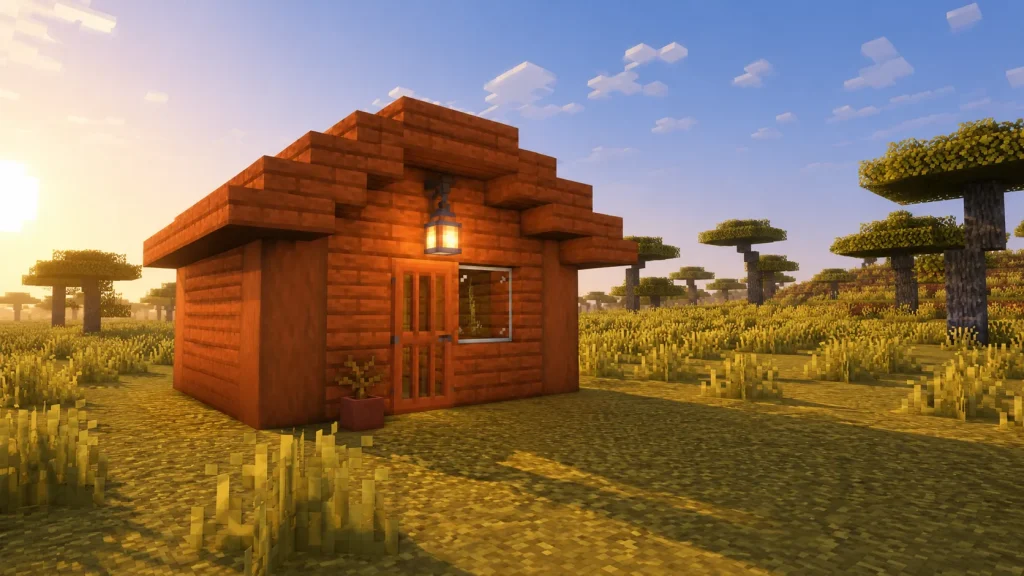
1. Acacia Starter Box Home
Your first night doesn’t have to be an ugly dirt hut. This is a simple 6×6 box with a slightly pitched roof, but the acacia grain does the heavy lifting to make it read as deliberate rather than desperate.
Walls are acacia planks with stripped acacia log corners as posts. The roof uses acacia stairs and slabs in a shallow gable, and a single acacia door sits below one glass-pane window. A lantern hangs off the front eave for early-game mob deterrence.
Keep it small on night one, then knock out the back wall later to extend it into a proper cottage without wasting the original footprint.
2. Coarse Dirt Dugout Den
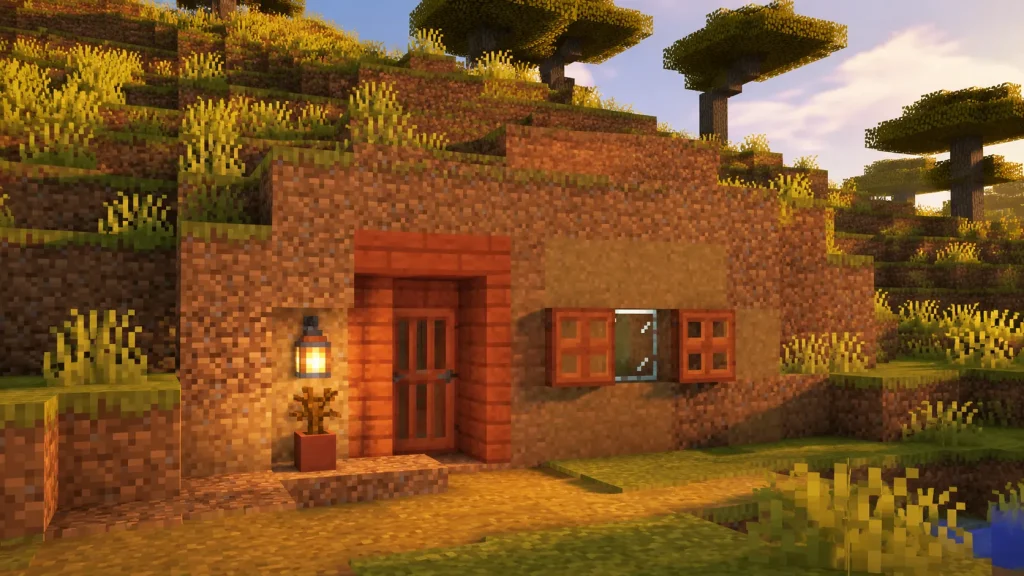
When you spawn on the edge of a savanna plateau, dig in instead of building up. This home is carved into the side of a low mesa-style rise, with only its face exposed to the world.
The exposed front is coarse dirt and packed mud with an acacia plank door frame, a single glass window, and acacia trapdoors folded down as shutters. Inside, the walls stay as raw stone and dirt, lit by torches and one lantern by the entrance.
It’s the fastest safe shelter in the biome and blends into the terrain so well that wandering mobs mostly ignore it.
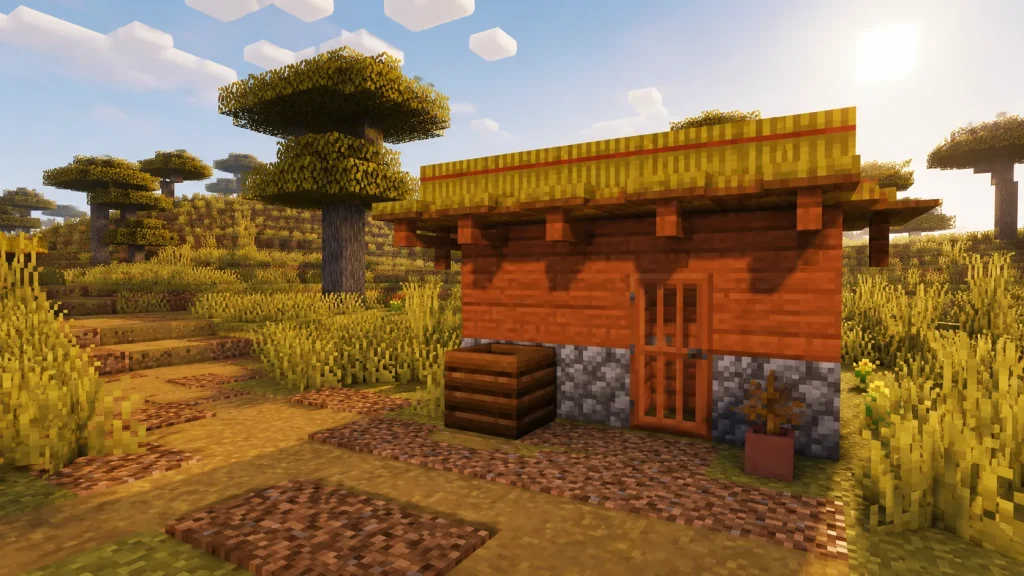
3. Hay-Roofed Trailhouse
A tiny roadside shack built for a survival world where you’re constantly on the move. The whole thing is barely 4×5, just enough for a bed, a furnace, and a chest.
The base is cobblestone and acacia planks, but the standout is the roof: hay bales laid across acacia fence rafters for a thatched farmstead look. A composter and a flower pot with a dead bush sit by the door for that dusty trail-stop feel.
Line up two or three of these along a path between bases and you’ve got a working travel route with beds every few hundred blocks.
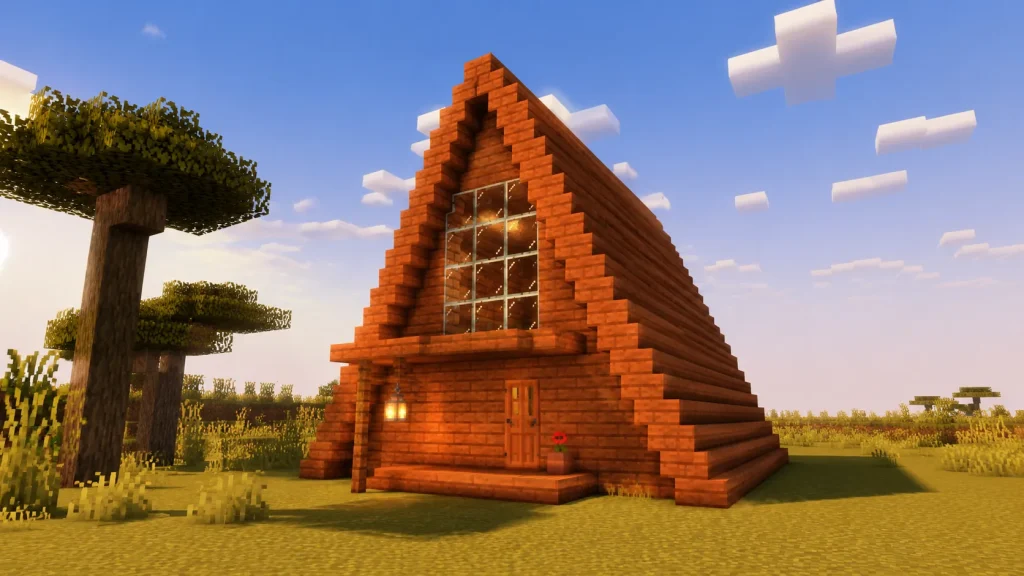
4. Compact Acacia A-Frame
An A-frame is the cheapest way to make a small footprint feel tall and intentional. This one runs the roof straight to the ground, so the walls basically are the roof.
The steep sides are acacia stairs stacked into a full triangle, with a front gable filled by acacia planks, a large glass-pane window, and an acacia door. A short acacia slab porch juts out front with a lantern on a fence post.
Build the frame two blocks wider than you think you need — A-frames eat floor space fast because the sloped walls cut into the interior.
Acacia Aesthetic Cabins
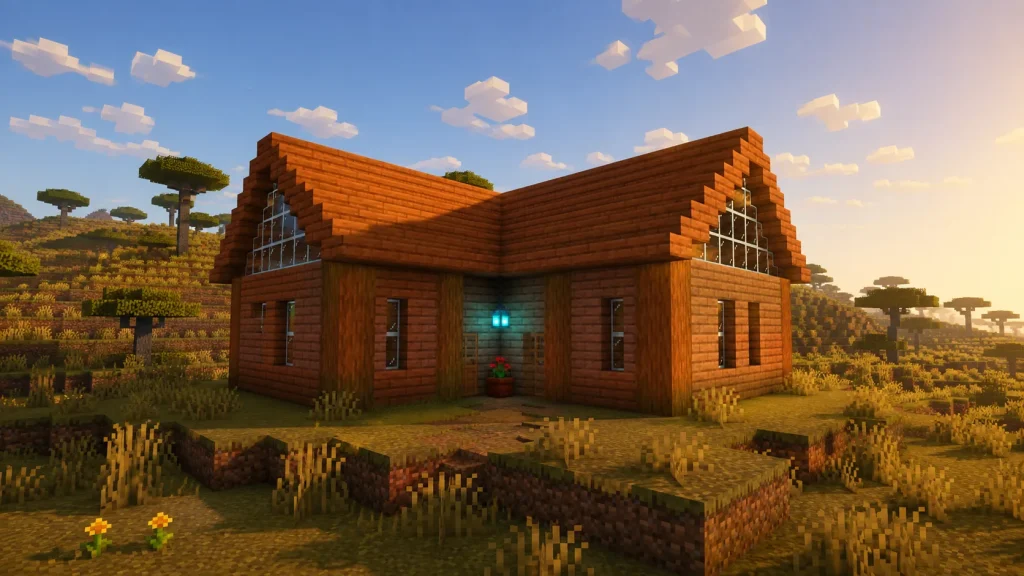
5. Twin-Gable Acacia Cottage
Two small gabled sections joined at a right angle give this cottage an L-shape that instantly looks more designed than a single box. The join creates a natural sheltered corner for an entrance.
Walls mix acacia planks with stripped acacia log framing, and both roofs are acacia stairs and slabs in matching shallow gables. Glass panes fill the gable ends, and a soul lantern hangs in the entry corner over a flower pot of poppies.
Set it on a slight rise so the two roof pitches read clearly against the flat savanna behind it.
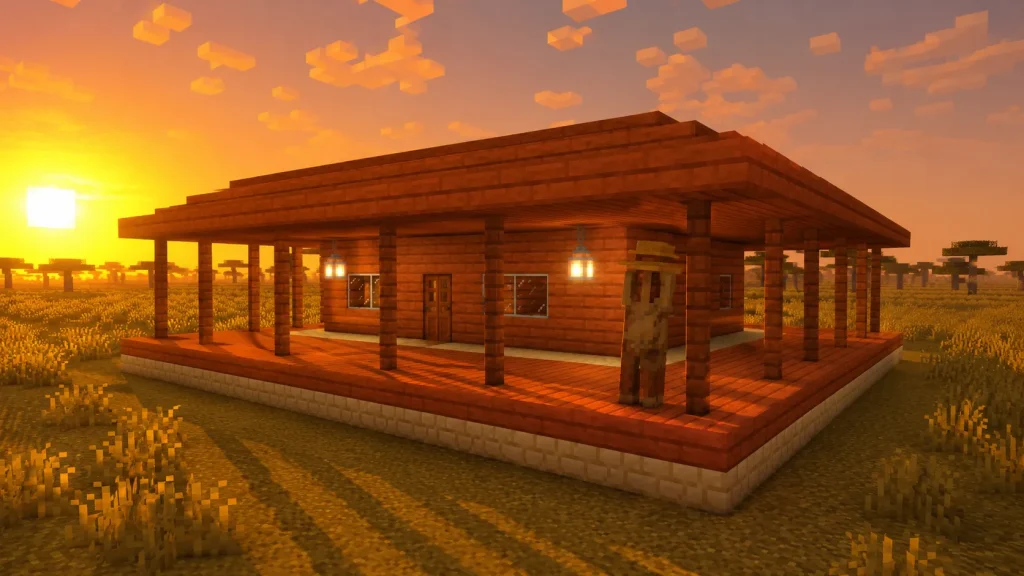
6. Wraparound Porch Homestead
Nothing says savanna ranch like a deep porch you can walk the whole way around. The porch is the personality here; the house itself is a plain 7×7.
The core is acacia planks with a smooth sandstone foundation, and the wraparound porch uses acacia fences as posts, acacia slabs as the deck, and an acacia stair-and-slab shed roof over it. Two lanterns hang between the posts and an armor stand leans in one corner like a scarecrow.
Face the longest porch stretch west so the low evening sun floods the deck with amber light.
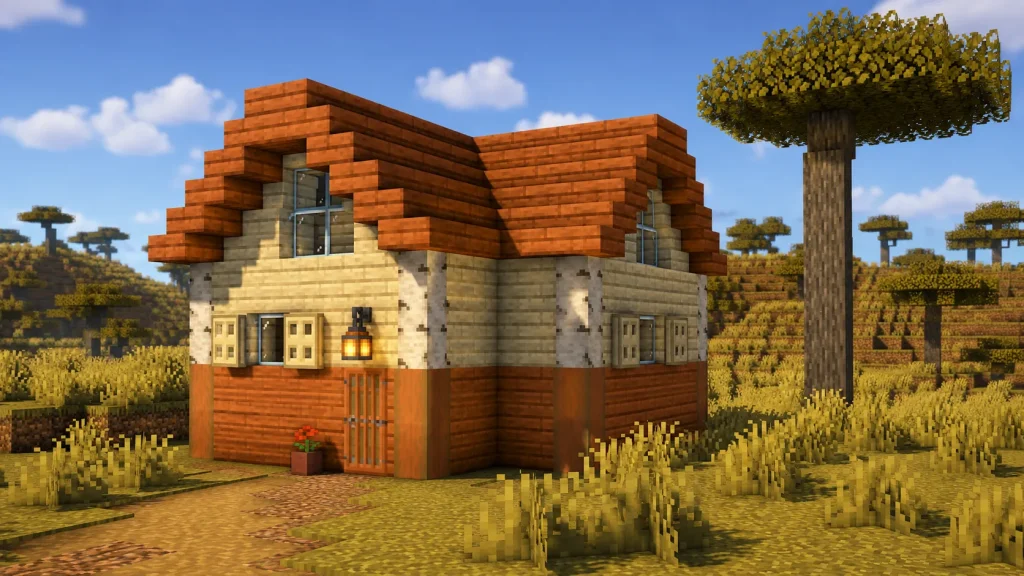
7. Acacia and Birch Contrast Cabin
Acacia’s orange reads even warmer next to birch’s pale cream, and this cabin plays the two off each other panel by panel. The result feels crafted rather than mono-material.
The lower half is acacia planks and stripped acacia logs; the upper half switches to birch planks with birch log corners. The roof is acacia stairs, tying the palette back together up top, and birch trapdoors act as flip-out window shutters.
Keep the split line consistent all the way around at the same block height, or the two-tone effect turns into visual noise.
8. Split-Level Acacia House
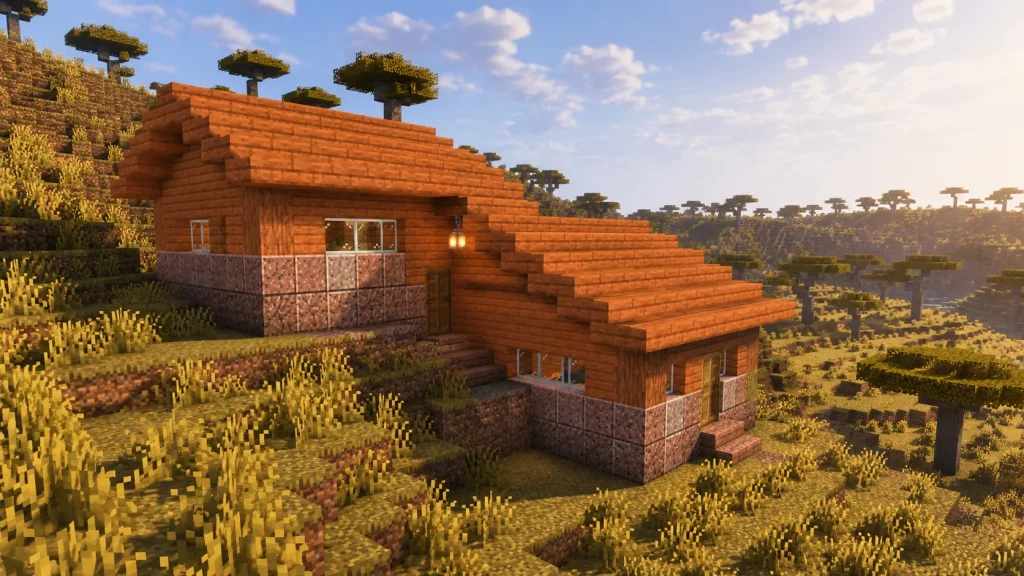
Savanna terrain is rarely perfectly flat, so lean into the bumps with a split-level. One half of the house sits a block or two higher than the other, connected by a short interior step.
Both levels use acacia planks over a granite foundation, with granite wall accents on the lower half to ground it. The roofs are staggered acacia stair gables at two different heights, and a lantern hangs where the two roofs meet.
Build the higher section into the natural slope rather than pillaring it up, so it looks like the terrain, not scaffolding.
Terracotta Village-Style Homes
9. Orange Terracotta Adobe House
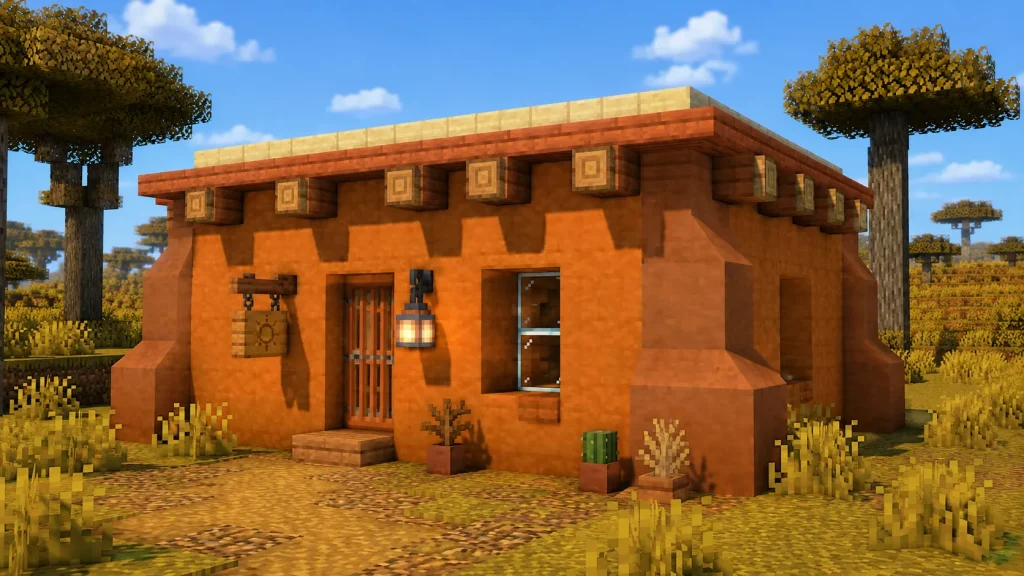
Terracotta is the savanna’s secret weapon — it’s the color of sun-baked clay and pairs perfectly with acacia trim. This home goes full adobe with rounded, chunky walls.
Walls are orange terracotta with plain terracotta corners, topped by a flat roof of smooth sandstone slabs edged in acacia. Acacia log beams poke out beneath the roofline like exposed rafters, and a hanging acacia sign marks the door.
Round off the wall corners with a diagonal block or two rather than leaving them perfectly square to sell the hand-packed adobe look.
10. Sun-Baked Clay Courtyard Home
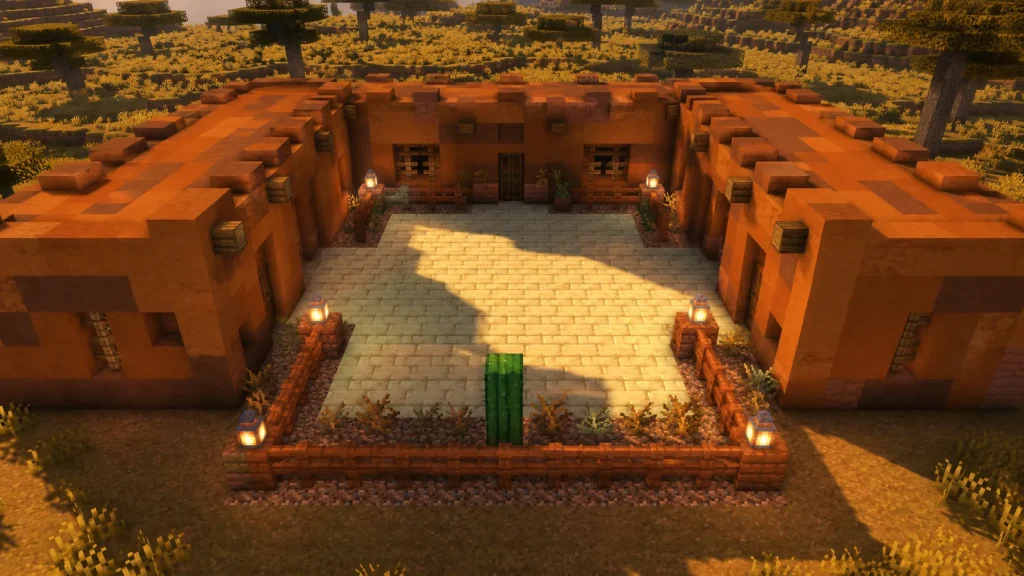
Wrap the house around an open central courtyard and you get a shaded interior space that feels like a desert-town home. It’s a U-shape open to one side.
The walls blend orange and brown terracotta, the courtyard floor is smooth sandstone with coarse dirt planting beds, and acacia fences frame a small garden of dead bushes and cactus. A lantern sits on each courtyard corner post.
Keep the courtyard at least 5×5 so it feels like a room, not an air gap between two walls.
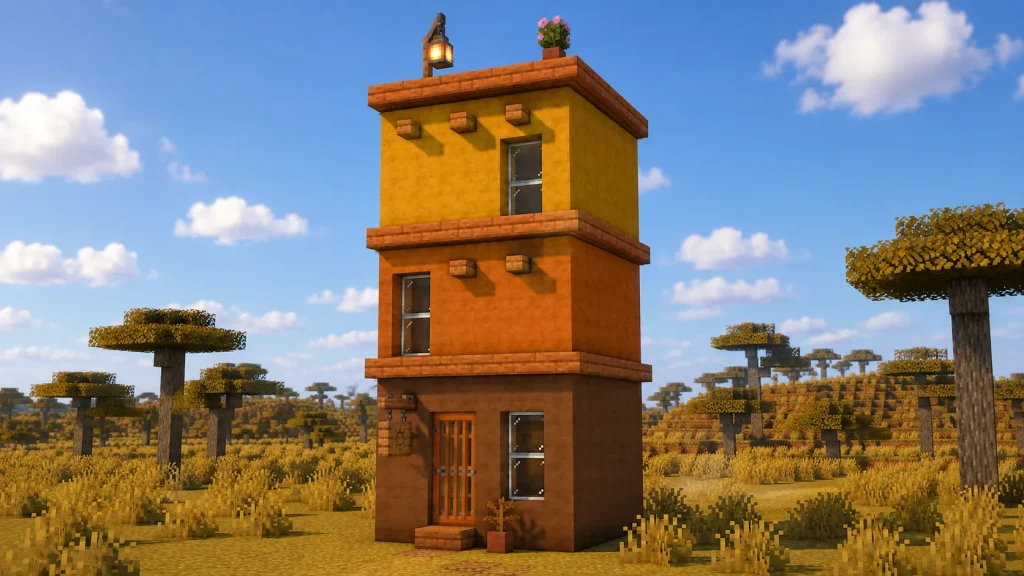
11. Layered Terracotta Townhouse
A taller, narrow build for players who want savanna style without a big footprint. Three stories stacked on a 5×5 base, each floor a slightly different terracotta shade.
The ground floor is brown terracotta, the middle orange terracotta, and the top yellow terracotta, all separated by acacia slab belt courses. A flat acacia-edged roof up top doubles as a terrace with a lantern and a potted azalea.
Shift each floor’s window placement so they don’t stack in a rigid column — the offset makes the tall shape feel lived-in.
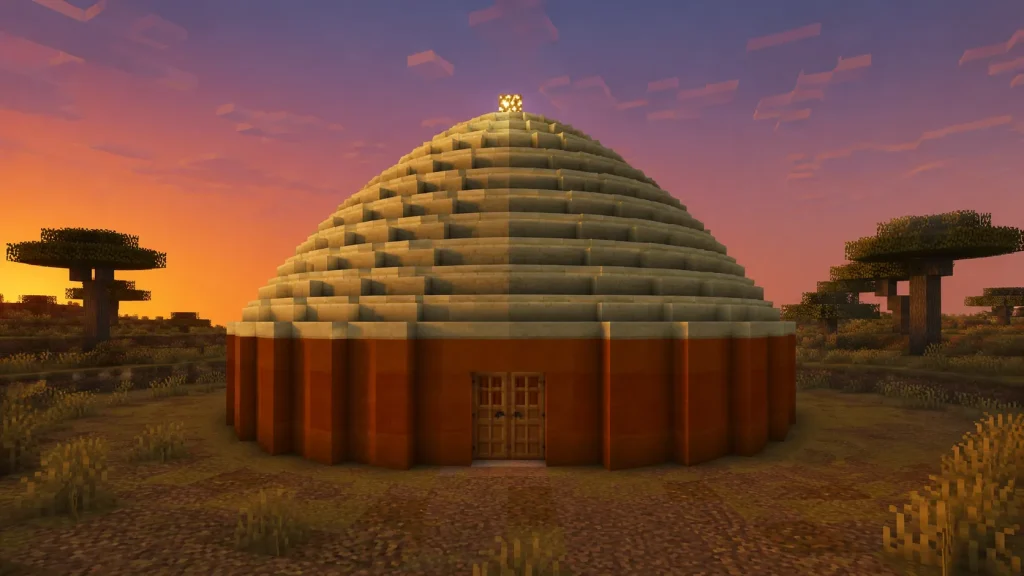
12. Terracotta Dome Roundhouse
A domed roundhouse is a striking break from all the boxes and gables, and terracotta’s earthy tone suits the shape. The circular base gives it a warm, kiln-like presence.
The curved walls are orange terracotta stepped into a rough circle, and the dome is built from smooth sandstone stairs and slabs corbeled inward. A single glowstone block caps the peak, glowing through a small opening, with acacia doors set into the round wall.
Draw the circle on the ground first with a rough radius guide — domes fall apart fast if the base isn’t symmetrical.
Cliffside and Elevated Builds
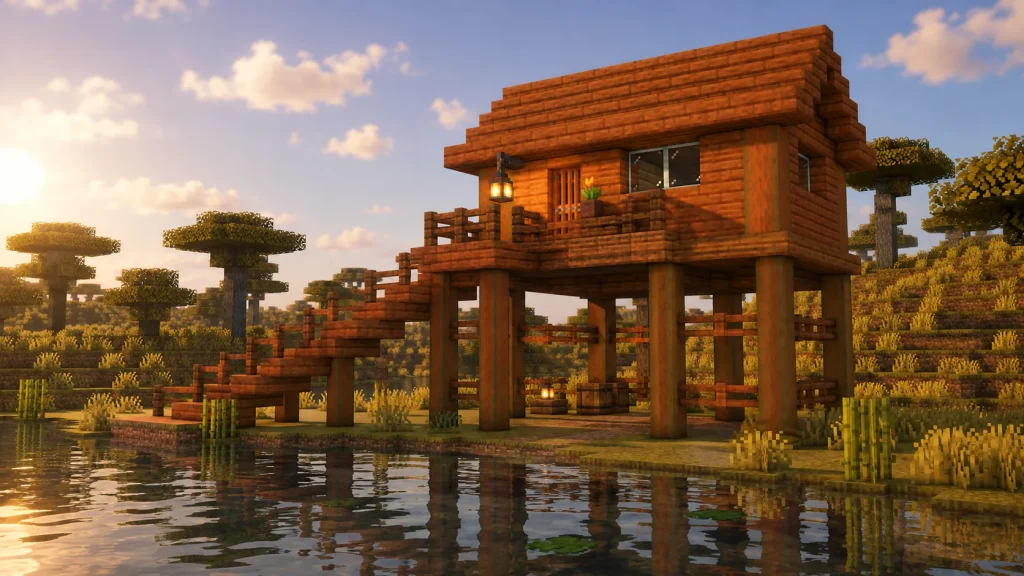
13. Acacia Stilt House
Savanna floods are rare, but a stilt house looks fantastic on a lakeshore or perched over a dry ravine. Raising the floor also creates covered space underneath for storage or a pen.
The stilts are stripped acacia logs, the floor and walls are acacia planks, and the roof is a shallow acacia stair gable. An acacia fence ladder-rail leads up to a small landing deck with a lantern and a flower pot of orange tulips.
Cross-brace the stilts with acacia fences between the posts so the underside reads as structural, not floating.
14. Cliffside Terrace Home
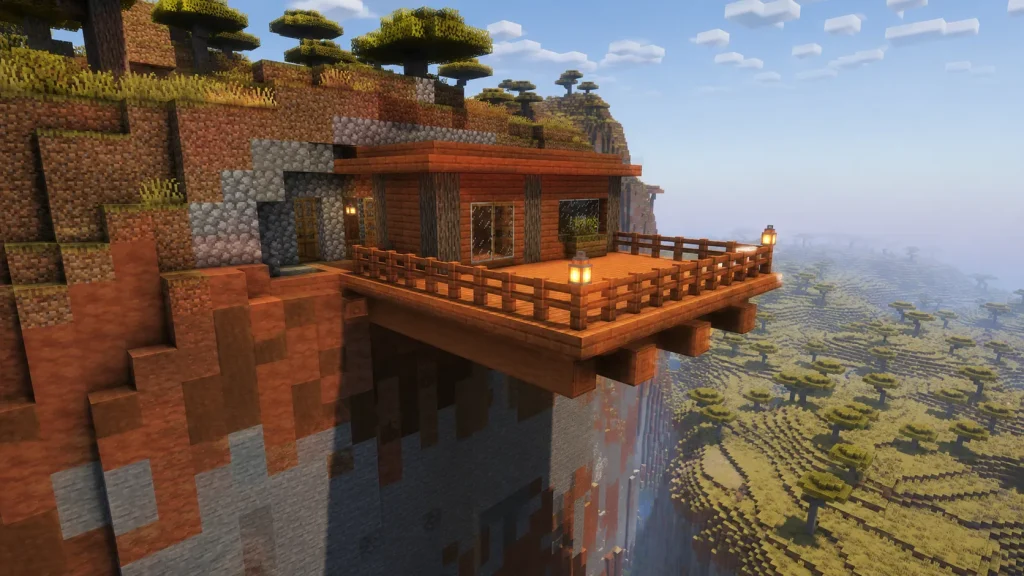
Savanna plateaus often end in sharp drops, and building right at the edge gives you a terrace with a view. Half the house tucks into the cliff, half cantilevers over the edge.
The rear walls are cobblestone and coarse dirt where they meet the cliff, transitioning to acacia planks for the exposed front. The overhanging terrace floor is acacia slabs on log supports, railed with acacia fences and lit by two lanterns.
Anchor at least a third of the floor into solid cliff rock so the cantilever looks supported rather than glued on.
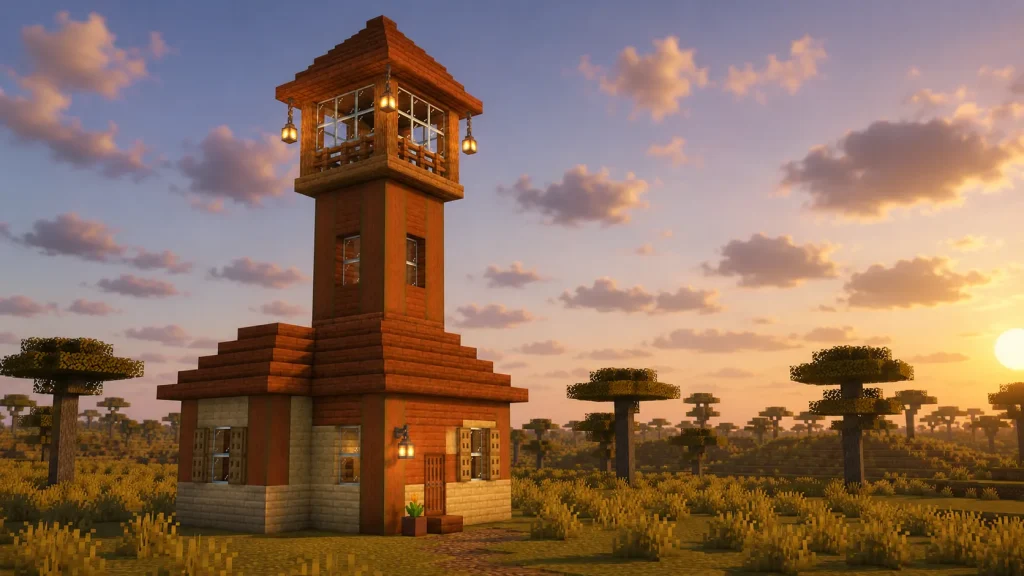
15. Savanna Watchtower Home
Combine a home and a lookout into one vertical build. The living space is at the base; the tower up top is pure view and mob-spotting.
The base is smooth sandstone and acacia planks, and the square tower rises in stripped acacia logs with glass-pane windows on all four sides at the top. A small acacia stair roof caps it, and a lantern hangs at each tower corner to light it up at night.
Keep the tower footprint to 3×3 so it stays slender — a fat watchtower just looks like a second house stacked on the first.
16. Acacia Canopy Treehouse
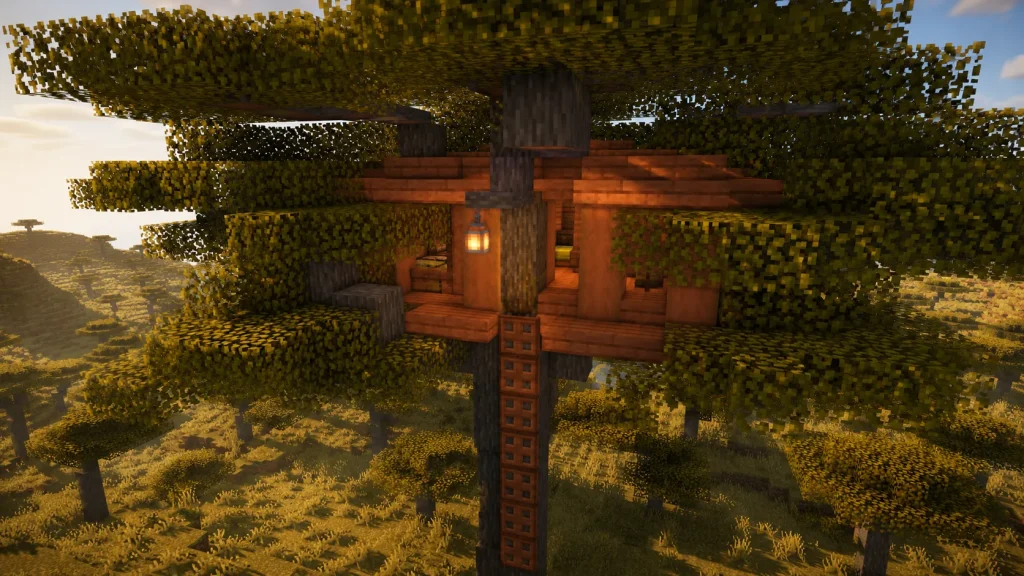
Savanna acacia trees have those wide flat canopies that practically beg for a platform nested into them. This treehouse sits among the branches rather than replacing the tree.
The platform and walls are acacia planks with stripped acacia log posts wrapping the existing trunk, and the roof is acacia slabs kept low to hide beneath the canopy. Leaf blocks are left in place around the walls, and a lantern hangs from a branch by the entry ladder.
Build around a naturally tall acacia if you can find one; forcing a bonemeal tree into shape rarely gives you enough canopy to hide in.
Grand Savanna Estates
17. Sprawling Ranch Estate
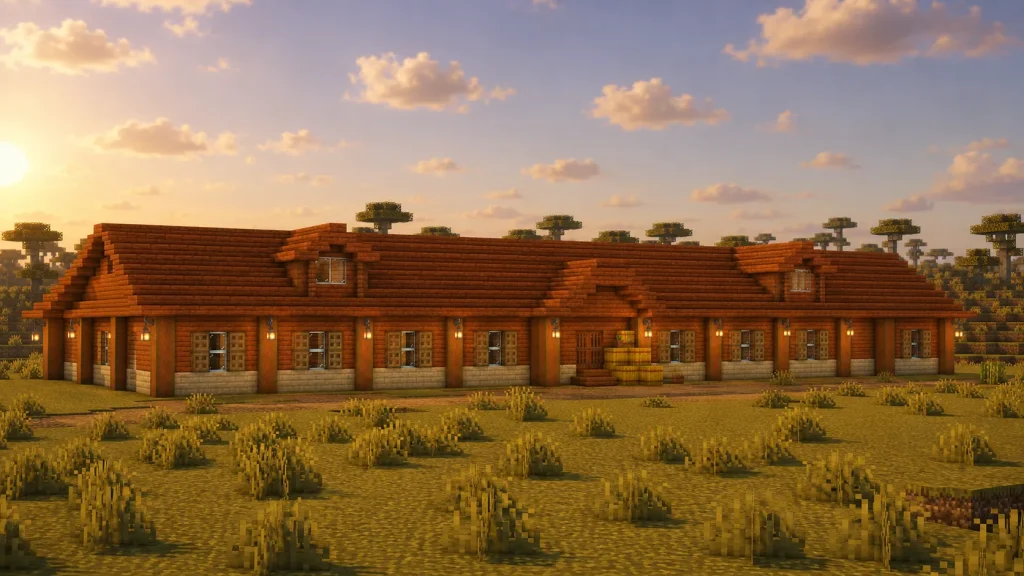
Go wide instead of tall for a proper savanna ranch that eats up the flat horizon. This is a long single-story house with multiple connected wings.
Walls are acacia planks over a smooth sandstone base, with stripped acacia log posts breaking up the long facade into bays. The roof is a continuous low acacia stair gable running the full length, with lanterns spaced along the eave and a hay bale stack by the entrance.
Break the roofline with one or two small dormers so a house this long doesn’t turn into a monotonous shed.
18. Red Sandstone Manor
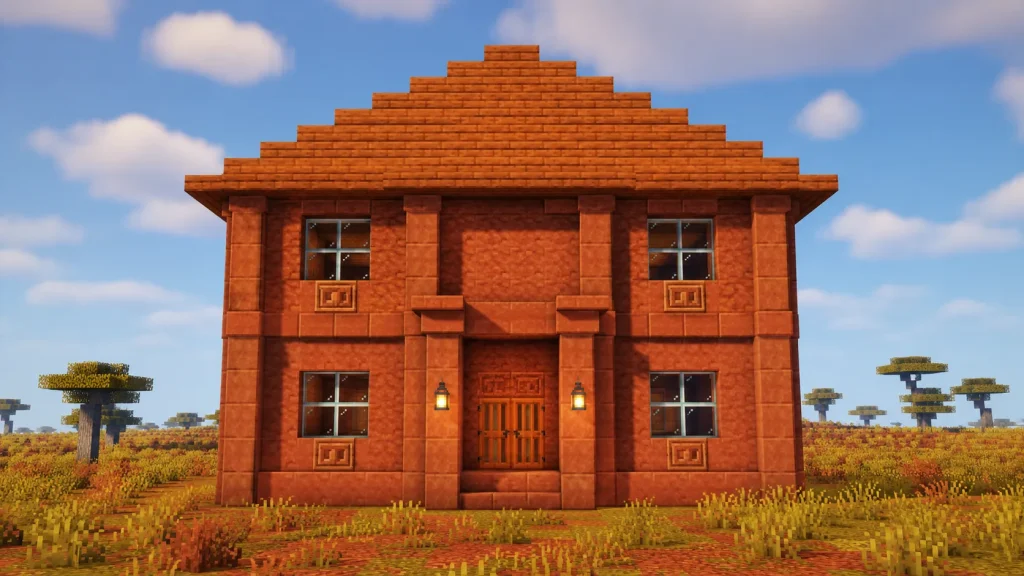
Red sandstone leans into the reddish savanna soil tones and gives an estate a heavier, older feel. This is a symmetrical two-story manor with a central entrance.
The walls are red sandstone and cut red sandstone with smooth red sandstone pillars framing the door, and the roof is a steeper acacia stair gable for contrast. Chiseled red sandstone panels sit under each window, and two lanterns flank the double acacia doors.
Keep the facade perfectly mirror-symmetrical around the door — manors live or die on that central balance.
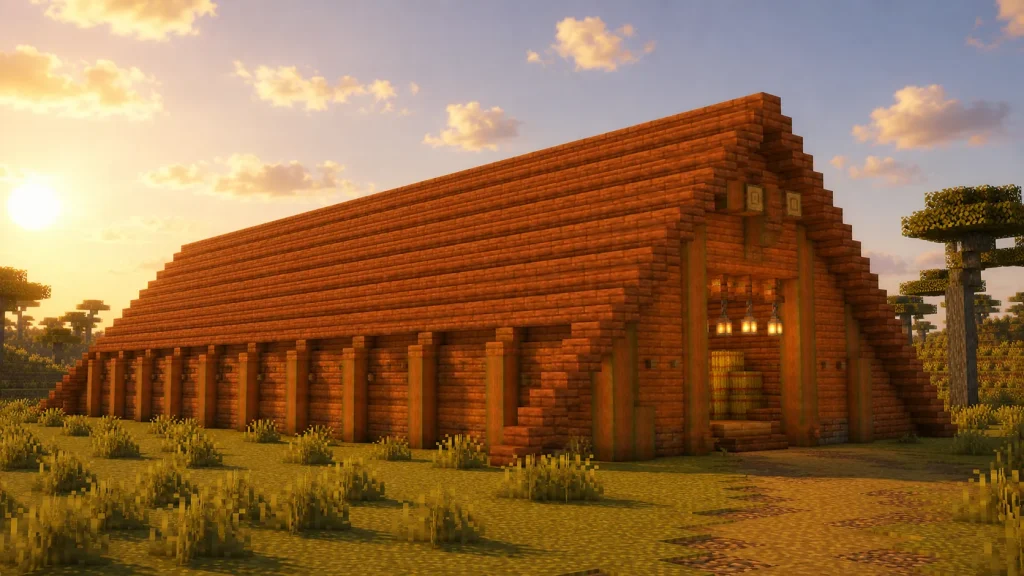
19. Savanna Longhouse
A single long hall under one big roof, inspired by communal longhouse builds but recolored for the savanna. It’s one open interior room from end to end.
The walls are acacia planks with a stripped acacia log frame every few blocks like ribs, and the tall roof is acacia stairs sweeping down nearly to the ground on both sides. Hay bales line one interior wall and lanterns hang from a central acacia beam.
Make it at least three times longer than it is wide, or it reads as a normal house with an oversized roof instead of a longhouse.
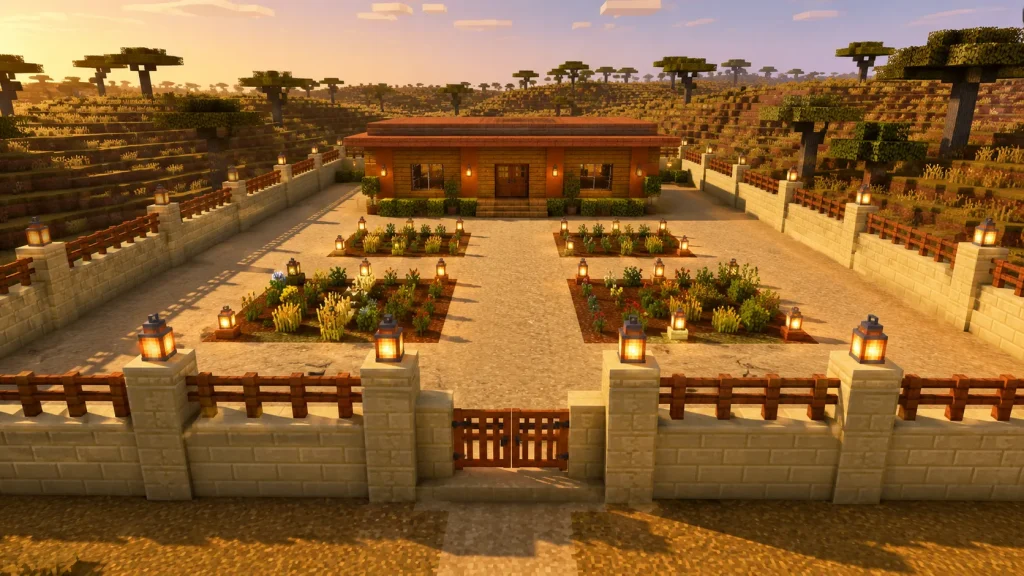
20. Walled Compound Villa
For a base you actually want to defend, wrap the whole property in a low wall. The villa sits inside with a gated courtyard between the wall and the front door.
The perimeter wall is smooth sandstone with acacia fence railings on top, and the villa itself is orange terracotta and acacia planks under a flat acacia-slab roof. The gate is a pair of acacia fence gates, and lanterns sit on the wall posts every few blocks.
Leave a decent gap between wall and house so the courtyard feels like usable space for gardens or pens, not a tight moat.
Functional Savanna Homes
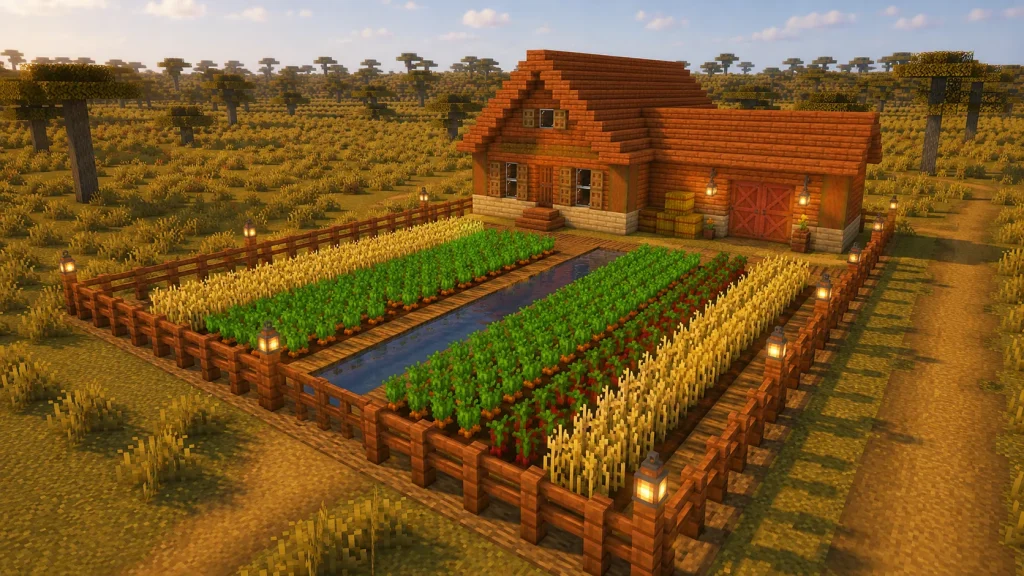
21. Savanna Farmhouse with Fields
A working farmhouse that treats the surrounding crop fields as part of the build. The house anchors one corner of a tidy plot of tilled land.
The house is acacia planks with a smooth sandstone base and an acacia stair gable roof, and the fields are farmland edged with acacia fences growing wheat, carrots, and beetroot. A composter, a stack of hay bales, and a couple of lanterns sit by the barn-style side door.
Run a water channel down the middle of the fields so it doubles as irrigation and a visual line pulling the eye toward the house.
22. Waterhole Lodge
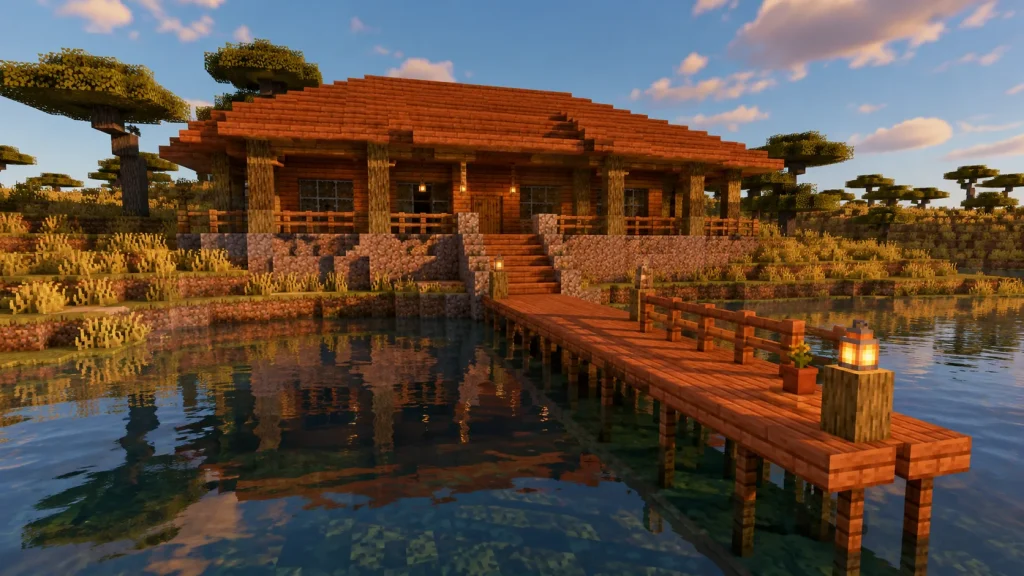
Savanna waterholes are natural gathering points, and a lodge on the bank makes the most of the rare water in the biome. The build steps down toward a small dock.
The lodge is stripped acacia logs and acacia planks with a granite foundation where it meets the water, under a wide acacia stair roof. An acacia slab dock extends over the water on fence-post stilts, with a lantern at its end and a flower pot on the railing.
Angle the whole lodge to face the widest part of the waterhole so the dock and the reflection line up in view.
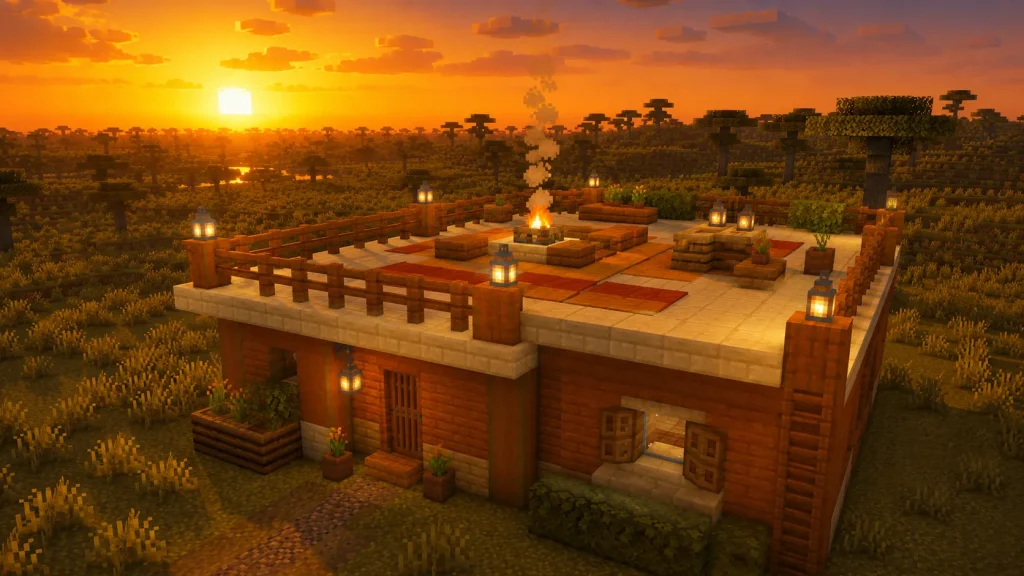
23. Sunset Rooftop Lounge Home
The savanna’s best feature is its sunsets, so this home is designed entirely around watching them from the roof. The living space below is almost an afterthought.
The house is acacia planks and orange terracotta with a flat smooth-sandstone-slab roof that becomes the lounge, railed in acacia fences. Up top sit campfires for ambient light, carpets in warm colors as a seating area, and lanterns on the corner posts.
Orient the open side of the rooftop due west, and keep the railing low on that edge so nothing blocks the sinking sun.
That’s 23 ways to turn the savanna from a biome you pass through into one you settle in. Whether you start with the coarse dirt dugout on night one or commit to the walled compound villa as a forever base, the trick is the same: let the acacia’s orange grain and those long golden sunsets do the styling for you. Pick the one that fits your current world, and build it before the sun goes down.